
By M R Yuvatha, Senior Correspondent, Global Consultants Review ,
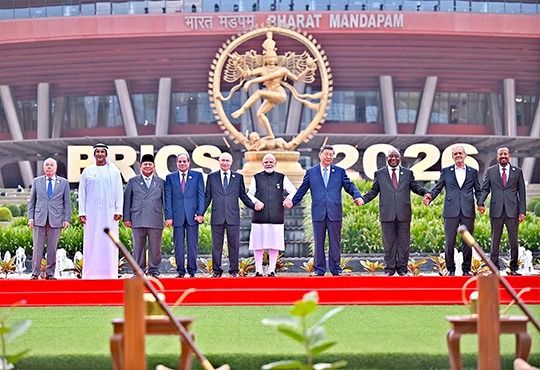
The 18th BRICS Summit, held on 12-13 September 2026 at Bharat Mandapam in New Delhi under India's chairship, delivered a sharp focus on practical economic cooperation, marking 20 years since the bloc's founding in 2006. The New Delhi Declaration a 45-page, 140-point document adopted by consensus set out the bloc's positions on trade facilitation, cross-border payments, local-currency settlement, development finance, digital infrastructure, resilient supply chains, MSME support and sector-specific initiatives, alongside its statements on terrorism, West Asia and global-governance reform.
Reaching that consensus was itself notable. The declaration was adopted only after India worked through sharp differences between the UAE and Iran over the West Asia conflict, and the final text stopped short of any direct reference to the US strikes on Iran or Iran's retaliatory strikes on Gulf Arab states.
BRICS's 2024-25 expansion adding Egypt, Ethiopia, Iran, Saudi Arabia and the UAE, then Indonesia, plus ten new partner countries including Kazakhstan, Belarus, Vietnam, Malaysia and Nigeria has widened the bloc's economic reach but also its internal divisions. That the declaration still strongly condemned the April 2025 Pahalgam terror attack and secured unanimous sign-off across that divided membership was read in Delhi as a diplomatic win in its own right.
The preceding BRICS Business Forum, held on 11 September and billed as the largest in the bloc's history, drew government leaders, the BRICS Business Council, the BRICS Women's Business Alliance whose Leaders' Session featured more than 200 women business leaders and senior executives from member and partner countries.
Prime Minister Narendra Modi told the forum that BRICS's 21-country family (members plus partners) now accounts for roughly 50 percent of the world's population, 40 percent of global GDP and more than 25 percent of global trade, and that combined BRICS GDP has grown nearly four-and-a-half-fold since 2006 against a roughly two-and-a-half-fold rise in world GDP over the same period. He set the business community three concrete targets: identify the top 10 barriers to intra-BRICS trade, help 100 BRICS startups a year scale into other BRICS markets, and build 1,000 new cross-border business partnerships with the BRICS Business Council asked to track progress annually.
Business leaders who took part included:
The outcomes give companies in trade, manufacturing, finance, technology, agriculture, energy, logistics and infrastructure concrete platforms to work with.
Collective opposition to unilateral tariffs, non-tariff barriers and coercive trade measures was a dominant theme. The declaration raised serious concern over such measures and called for restoring a fully functioning, binding two-tier WTO dispute settlement mechanism, while also opposing climate-linked trade barriers such as carbon border adjustment mechanisms that risk becoming protectionist and disproportionately affect developing economies.
On global value chains, the Trade track adopted a 2026–2030 Global Value Chains Action Plan, including a Technical Council, the BRICS Connect initiative and a joint study on market opening and economic diversification. Customs administrations committed to voluntarily implement the BRICS Authorised Economic Operator (AEO) Action Plan 2026 and continue work on AEO Mutual Recognition Arrangements, which give trusted businesses simplified customs procedures. Intra-BRICS merchandise trade reached $1.17 trillion in 2024, and these steps are aimed squarely at reducing friction in that trade and helping companies diversify supply chains within the bloc.
The declaration made clear BRICS has no plans for a single common currency; the focus stays on interoperable national payment systems and greater use of local currencies for trade and investment. The BRICS Payment Task Force, made up of central bank experts, continues working without a one-size-fits-all mandate to make cross-border payments faster, cheaper and safer.
Indian officials pointed to the Unified Payments Interface (UPI), now live in multiple countries and processing hundreds of billions of transactions a year, as a possible model for the bloc. Wider local-currency channels are expected to cut transaction costs and currency risk for exporters, importers and investors across BRICS economies.
The New Development Bank was encouraged to expand local-currency financing, diversify its funding and mobilise more resources for infrastructure and sustainable development. NDB President Dilma Rousseff has been steering the bank from roughly 25-30 percent local-currency lending today toward more than 45 percent of its portfolio by 2031, under a new five-year strategy that also prioritises deeper local capital markets and explores tokenisation.
By the end of 2025, the bank had approved 139 projects worth a combined $42.9 billion across energy, transport, water, environmental, social and digital infrastructure. It has also built up a large footprint in China's Panda bond market cumulative issuance reached 94.5 billion yuan after a 7 billion, yuan sale on 8 September, just ahead of the summit and is preparing its first rupee-bond issuance. A $7.5 billion, five-year NDB commitment to India (roughly $5 billion in lending plus a $2.5-billion-equivalent rupee bond programme) was cited as a concrete example of that local-currency push.
Additional tools in the works include BRICS Multilateral Guarantees, piloted within the NDB to mobilise private capital and lower financing costs, and expanded credit lines among BRICS development banks to support MSMEs in intra-bloc trade giving companies better access to long-term project finance with less foreign-exchange exposure.
Technical work continues on a proposed New Investment Platform through a study group under the BRICS Finance Track, with members favouring a phased, consensus-based approach over an immediate new mechanism.
Discussions also advanced on a BRICS Insurance Resilience Centre to build collective reinsurance capacity, and India proposed a BRICS Risk Lab at the GIFT City International Financial Services Centre in Gujarat, which other members expressed interest in taking forward. The idea is a hub open to interested members for risk assessment, insurance and related financial services supporting cross-border projects, aimed at pulling private capital into infrastructure, clean energy and urban development.
India's chairship put strong emphasis on MSMEs. The Trade track adopted a workplan on MSME internationalisation that includes the Jaipur Consensus, calling for a study of a BRICS Invoice Discounting Mechanism and guiding principles for assessing export-oriented MSME credit, aimed at unlocking working capital.
The SME Working Group adopted a framework for a BRICS MSME Cooperation Portal and an MSME finance dialogue. The year also produced a BRICS Incubator Network, a BRICS MSME Portal and a BRICS Startup Innovation Fund directly aimed at the financing and market-access barriers smaller firms and startups face when expanding within BRICS.
Also Read: How India's GCCs Are Quietly Taking Over AI in 2026
Leaders visited the Bharat Innovates Exposition, where India showcased UPI, Aadhaar, the Open Network for Digital Commerce (ONDC) and its healthcare platforms. The declaration floated a BRICS repository for digital public infrastructure and pilot DPI projects across member countries.
AI governance was formally folded into the BRICS agenda for the first time, with a commitment to implement the BRICS Leaders' Statement on the Global Governance of Artificial Intelligence, referencing India's February 2026 AI Impact Summit and the World AI Conference in Shanghai. AI now sits alongside trade and finance as a core pillar of cooperation, with parallel commitments on cybersecurity and countering cross-border scam networks opening space for technology firms and fintechs to work on interoperable systems and standards across the bloc.
Four new agriculture initiatives moved forward: agroecology and regenerative agriculture for climate resilience; digital agriculture; a collaborative, non-binding, farmer-centric BRICS AGRIN (Agro-Inputs, Genetic Resources and Information Network); and support for a Global Forum on Farmers' Rights in Seed Systems. Discussions continued on operationalising the BRICS Grain Exchange and widening it to more agricultural commodities opportunities for companies across agro-inputs, technology, logistics and commodity trading.
The declaration backs resilient critical-mineral supply chains, and India's chairship advanced discussions on critical-minerals collaboration. In his closing remarks, PM Modi went further, warning that the weaponisation of critical minerals could become a hurdle to shared growth and development a signal that supply-chain resilience in this sector will stay a priority beyond the summit. Members also welcomed Guiding Principles on Smart Grids and Energy Storage, alongside India's initiative to set up a BRICS Digital Centre of Excellence for Smart Grids and Energy Storage opening avenues for companies in mining, renewables, battery technology and grid infrastructure.
The Transport track adopted a Logistics Supply-Chain Cooperation Framework, and secure sea lanes and supply routes were repeatedly flagged at the Business Forum as essential to global trade. A proposal for a Seafarers' Emergency Support Network also moved forward India supplies a significant share of the world's trained seafarers supporting shipping, logistics and manufacturing firms that depend on reliable cross-border goods movement.
Also Read: India Urges BRICS to Protect Heritage and Embrace Ethical AI
With no permanent BRICS secretariat, PM Modi proposed a Continuity and Implementation Mechanism built around the Troika of previous, current and incoming chairs to track follow-through on commitments. A BRICS Task Force on Growth and Development was also established as a dedicated platform for shared development challenges across BRICS and other emerging economies.
Members also reached consensus on a BRICS Integrated Early Warning System for preventing and responding to infectious diseases, alongside new Early Warning Data Integration Guidelines for disaster management both framed by Modi as direct responses to how pandemics, climate disasters and supply-chain shocks now ripple well beyond any single region. For businesses, these sit alongside the trade and finance mechanisms as part of the same resilience push. China takes over the chairship in 2027 and will host the 19th Summit.
The Business Forum and adjoining bilateral meetings reinforced business-to-business links across the bloc including engagement from South African President Cyril Ramaphosa on intra-BRICS trade and African infrastructure investment.
The New Delhi Declaration prioritised actionable, development-oriented cooperation over declaratory language, though real tests remain: differing national approaches to payments, an expanded bloc with sharper internal divisions, and the follow-through needed once the chairship passes to Brazil-adjacent China in 2027.
Even so, the concrete mechanisms agreed on payments interoperability, NDB expansion, MSME finance, digital infrastructure, supply-chain resilience and investment platforms give companies across manufacturing, services, finance, technology, agriculture, energy and logistics a clearer roadmap for cross-border trade and investment within the expanded BRICS membership with the coming years determining how much of it converts into measurable results.
We use cookies to ensure you get the best experience on our website. Read more...