
By Riddhi D, Senior Correspondent ,
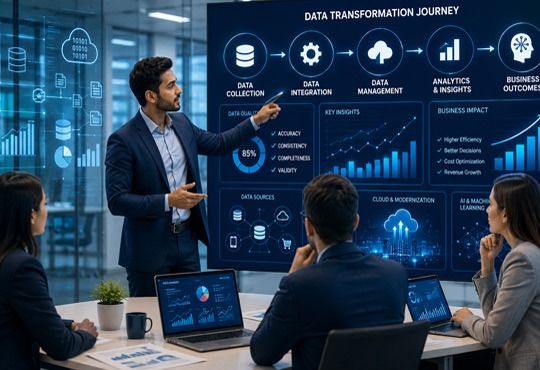
In today's digital economy, data has become one of the most valuable assets an organization possesses. Every customer interaction, financial transaction, supply chain movement, and operational process generates enormous amounts of information. However, collecting data alone is no longer enough. The real competitive advantage lies in transforming raw data into actionable business intelligence.
This is where data transformation consultants have emerged as strategic business partners. Rather than simply implementing technology, these professionals help organizations redesign how data is collected, integrated, managed, analyzed, and utilized across every business function.
As artificial intelligence (AI), machine learning, cloud computing, edge computing, and real-time analytics continue reshaping industries, organizations are increasingly investing in data transformation initiatives. According to industry analysts, global spending on data modernization and AI-enabled analytics continues to rise as companies prioritize digital resilience, operational efficiency, and customer-centric innovation.
Data transformation consulting has therefore evolved from an IT-focused service into a boardroom priority, influencing strategic decisions across healthcare, banking, retail, manufacturing, logistics, education, energy, and government sectors.
Data transformation is the process of converting raw, fragmented, or unstructured data into a clean, standardized, integrated, and usable format that supports business intelligence, reporting, predictive analytics, and AI applications.
The process involves:
Without proper transformation, organizations struggle with duplicate records, inconsistent reporting, inaccurate forecasts, and inefficient decision-making.
Data transformation consultants are specialists who combine business strategy, data engineering, cloud technologies, analytics, and governance expertise to help organizations unlock the value of their information assets.
Their role goes beyond technical implementation.
They help businesses answer critical questions such as:
In essence, they bridge the gap between technology investments and measurable business outcomes.
Organizations today face several challenges.
Companies generate information from:
Managing multiple data sources requires specialized expertise.
Industry studies estimate that poor-quality data costs businesses billions of dollars annually.
Common issues include:
Consultants establish governance frameworks that improve accuracy and consistency.
Artificial intelligence performs only as well as the data it receives.
Poor data leads to:
Data consultants ensure organizations build AI-ready information ecosystems.
Consultants create long-term roadmaps aligned with business goals.
This includes:
Many organizations continue operating legacy databases.
Consultants migrate information into modern cloud platforms while minimizing downtime.
Migration includes:
Businesses often use dozens of disconnected software platforms.
Consultants integrate these systems into unified environments that provide a single source of truth.
Cloud adoption continues accelerating.
Consultants help organizations migrate toward platforms such as:
Benefits include:
Modern dashboards enable executives to monitor:
Consultants develop customized BI solutions using modern visualization tools.
Organizations increasingly seek predictive insights.
Consultants build systems capable of forecasting:
Hospitals use transformed data for:
Financial institutions improve:
Retailers leverage transformed data for:
Factories utilize:
Educational institutions analyze:
Transportation companies optimize:
AI automates:
Machine learning continuously improves forecasting accuracy through historical datasets.
Edge computing enables faster processing near the data source, reducing latency for IoT and industrial applications.
Data fabric architectures connect distributed information without requiring full migration, enabling unified access across hybrid environments.
Instead of relying on centralized data teams, data mesh empowers business domains to own and manage their datasets while following shared governance standards.
Successful consultants combine technical and business capabilities.
Key skills include:
Many businesses continue operating decades-old systems.
Replacing them requires careful planning.
Employees often hesitate to adopt new technologies.
Consultants implement structured change management programs to encourage adoption.
As organizations centralize data, protecting sensitive information becomes even more important.
Consultants implement:
Businesses must comply with regulations such as:
Governance frameworks help reduce legal risks.
Organizations typically evaluate transformation initiatives using:
Several developments will define the future of data transformation consulting.
Future platforms will automatically cleanse, organize, and classify enterprise data.
Business users will receive AI-generated insights without needing technical expertise.
Organizations will increasingly rely on live analytics for operational decisions.
Virtual models of factories, hospitals, cities, and supply chains will become mainstream.
Consultants will also advise organizations on energy-efficient infrastructure and green cloud strategies.
Organizations should:
Data transformation has become a strategic necessity rather than a technology upgrade. Organizations that successfully modernize their data ecosystems gain deeper customer insights, faster decision-making capabilities, stronger operational efficiency, and a solid foundation for artificial intelligence initiatives.
Data transformation consultants play a crucial role in this journey by combining business expertise with technical excellence. Their ability to integrate systems, improve data quality, establish governance, and implement AI-ready architectures enables businesses to unlock the full value of their information assets.
As digital transformation accelerates across every industry, the demand for skilled data transformation consultants will continue to grow. Enterprises that invest in robust data strategies today will be better positioned to innovate, compete, and thrive in an increasingly data-driven world. In the coming years, successful organizations will not simply collect more data—they will transform it into meaningful intelligence that drives smarter decisions, sustainable growth, and lasting competitive advantage.
We use cookies to ensure you get the best experience on our website. Read more...