
By Tharani Sambu, Content Writer ,
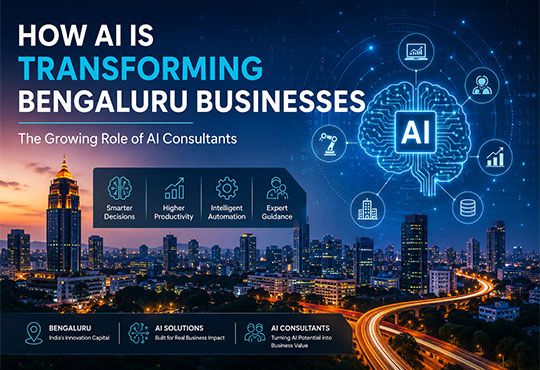 Bengaluru has long been known as one of India's biggest technology and startup hubs. Today, the city is entering another important phase: the rapid growth of artificial intelligence.
AI is no longer something businesses discuss only as a future technology. Companies are already exploring ways to use AI for customer service, data analysis, software development, marketing, automation, and decision-making.
The change is also visible in Bengaluru's business ecosystem. In June 2026, EY GDS launched its ey.ai Center for Reimagination in Bengaluru to help organizations explore AI-led transformation. In July, DXC Technology opened a Bengaluru AI hub designed to help enterprises move AI projects from experimentation toward production.
At the same time, India's AI startup ecosystem continues to expand. Google's 2026 India accelerator selected 20 AI-first startups working on areas including developer infrastructure, climate resilience, and other technology challenges.
All of this raises an important question for businesses:
If AI is changing so quickly, how can businesses know where to start and how to use it effectively?
This is where AI consultants can make a difference.
Bengaluru has a combination that makes it well suited for AI adoption: technology talent, startups, established companies, research activity, and a large ecosystem of businesses working with digital technologies.
For businesses, AI can provide opportunities to improve the way everyday work is done.
For example, companies can use AI to:
But adopting AI is not simply a matter of purchasing a tool and asking employees to start using it.
A company needs to understand which problems AI should solve, what information it should use, and how employees should work with it.
One of the biggest challenges businesses face is moving from experimenting with AI to using it in a meaningful way.
It is easy for a company to test a chatbot or generate content with an AI tool. The harder question is whether that technology is actually improving the business.
For example, imagine a company that spends hundreds of hours each month handling repetitive customer enquiries.
Instead of simply introducing an AI chatbot, the business needs to understand:
An AI consultant can help answer these questions and design a practical approach.
“The goal is not to use AI everywhere. The goal is to use AI where it creates real business value.”
Every business has different needs.
A retail company may want to improve customer recommendations. A financial services company may focus on data analysis and risk management. A manufacturing company may be interested in predictive maintenance or process automation.
An AI consultant can examine a company's existing processes and identify where AI could provide the greatest benefit.
This prevents businesses from adopting technology simply because it is trending.
Instead, AI becomes connected to a specific business objective.
AI adoption works better when there is a clear plan.
An AI consultant can help businesses decide:
A clear strategy can also help businesses avoid spending money on AI projects that do not solve an important problem.
Technology is only one part of AI adoption. People are another.
Employees may be interested in AI but unsure how it applies to their jobs. Others may worry that AI will replace parts of their work.
Consultants can help organizations introduce AI in a practical way through training and workshops.
Employees can learn how to use AI for tasks such as research, writing, summarizing information, analyzing documents, brainstorming, and automating repetitive work.
The objective should not be to remove people from the process.
It should be to help people spend less time on repetitive tasks and more time on work that requires creativity, judgment, communication, and problem-solving.
Another challenge is making AI work with the systems a company already uses.
A business may have information spread across customer relationship management platforms, databases, cloud applications, documents, and internal communication tools.
An AI consultant can help identify how AI can fit into these existing workflows.
For example, a sales team could use AI to summarize customer information before a meeting. A support team could use AI to organize customer enquiries. A finance team could use AI-assisted analysis to identify unusual patterns that require further investigation.
The technology becomes more valuable when it fits naturally into the way employees already work.
AI adoption also brings important questions about data.
Businesses need to know what information can be shared with AI systems and how sensitive information should be protected.
This becomes especially important for companies handling customer information, financial data, intellectual property, or confidential business documents.
AI consultants can help businesses establish responsible AI practices, including:
Responsible adoption can help businesses take advantage of AI without ignoring the risks that come with it.
One of the easiest mistakes businesses can make is measuring AI adoption by the number of employees using an AI tool.
Usage alone does not prove business value.
Instead, companies should look at measurable outcomes.
For example:
Before AI: An employee spends three hours preparing a weekly report.
After AI: The same process takes one hour, with the employee spending additional time reviewing and improving the final report.
That gives the business something meaningful to measure.
AI consultants can help organizations track metrics such as time saved, productivity improvements, operating costs, customer response times, and employee adoption.
The growth of AI in Bengaluru is not only about new software or startups.
It could influence how businesses hire, train employees, develop products, serve customers, and make decisions.
Bengaluru's existing technology ecosystem gives businesses an opportunity to experiment with AI, but successful adoption will depend on how effectively companies turn that technology into practical results.
The city is also seeing growing activity around AI-focused startups and enterprise solutions. For example, Bengaluru-based Vecton AI recently raised ₹6 crore in pre-seed funding to support AI transformation solutions for financial institutions.
This is one indication of how AI is moving beyond experimentation and into specific industry applications.
Businesses do not need to transform everything at once.
A better approach is to start with one or two clear problems.
For example:
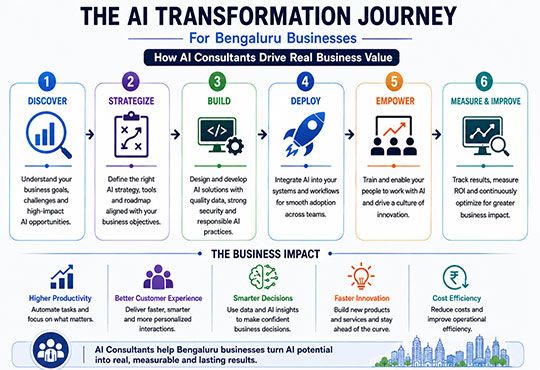
Step 1: Identify a repetitive or time-consuming business process.
Step 2: Evaluate whether AI can realistically improve it.
Step 3: Test the idea on a small scale.
Step 4: Measure the results.
Step 5: Train employees and improve the process.
Step 6: Expand the solution if it delivers measurable value.
An AI consultant can guide a company through these steps and help connect technology decisions with business goals.
As AI becomes more common, the role of AI consultants is likely to evolve.
Consultants will not simply be expected to explain what AI can do. Businesses will increasingly need professionals who understand technology, business processes, people, data, and implementation together.
That means the most valuable AI consulting will likely focus less on the technology itself and more on the results it creates.
For Bengaluru businesses, this could mean better productivity, faster innovation, improved customer experiences, and more efficient operations.
Bengaluru's AI growth presents a significant opportunity for businesses, but opportunity alone does not guarantee success.
Companies need to understand where AI can genuinely help, how employees should use it, how business data should be protected, and how results should be measured.
This is where AI consultants can play an increasingly important role.
They can help businesses move from “We should use AI” to “Here is how AI can solve a specific business problem.”
The future of AI in Bengaluru will not simply be about how advanced the technology becomes.
It will also depend on how effectively businesses use that technology to solve real problems.
We use cookies to ensure you get the best experience on our website. Read more...