
By Riddhi D, Senior Correspondent ,
 The consulting industry has always been built on one fundamental promise: helping organizations make better decisions. Traditionally, consultants relied on industry experience, market research, financial modeling, surveys, and expert judgment to provide strategic recommendations. While these methods continue to play an important role, today's business environment demands faster, more accurate, and data-backed insights than ever before.
This is where data science has become a game changer.
Organizations now generate enormous amounts of structured and unstructured data—from customer interactions and financial transactions to IoT sensors, social media, supply chains, and enterprise applications. According to industry estimates, the volume of global data continues to grow exponentially every year. However, raw data alone has little value unless organizations can convert it into meaningful insights.
Consulting firms have recognized this opportunity. Today, data science enables consultants to uncover hidden business patterns, predict future outcomes, automate complex analyses, personalize recommendations, and deliver measurable business value. Instead of relying solely on historical reports, consultants are now helping clients make proactive decisions based on predictive and prescriptive analytics.
Leading consulting firms such as McKinsey & Company, Boston Consulting Group (BCG), Bain & Company, Deloitte Consulting, PwC, EY, KPMG, Accenture, and IBM Consulting have significantly expanded their investments in data science capabilities, analytics platforms, artificial intelligence (AI), and machine learning (ML). Data scientists now work alongside management consultants, industry experts, economists, and technology specialists to solve increasingly complex business problems.
As businesses embrace digital transformation, the role of data science within consulting will only become more significant. Rather than replacing consultants, data science is empowering them to become faster, smarter, and more impactful advisors.
Data science combines several disciplines, including:
In consulting, data science helps organizations answer critical questions such as:
Rather than providing assumptions, consultants now deliver evidence-based recommendations supported by large-scale data analysis.
Consulting has evolved through several stages.
Earlier consulting engagements primarily involved:
Although effective, these methods often required months of research and were limited by available information.
With enterprise software, ERP systems, CRM platforms, and cloud technologies becoming widespread, consultants gained access to larger datasets.
Analytics became an important part of advisory services.
Today, consulting engagements increasingly involve:
Modern consulting projects combine business expertise with sophisticated analytical capabilities.
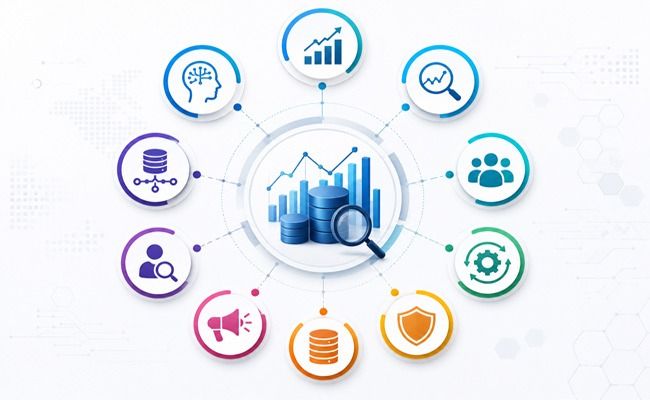
One of the biggest advantages of data science is enabling consultants to make decisions based on facts rather than assumptions.
Large datasets reveal:
Executives can therefore make strategic decisions with greater confidence.
Predictive analytics has become one of consulting's most valuable offerings.
Using historical data and machine learning algorithms, consultants can forecast:
Businesses can plan ahead instead of reacting after problems occur.
Understanding customers is central to business success.
Data science helps consultants analyze:
This enables businesses to create personalized experiences that improve retention and profitability.
Consultants frequently help organizations improve efficiency.
Data science identifies:
Organizations can significantly reduce costs while improving performance.
Businesses today face numerous risks:
Data science enables consultants to identify emerging risks before they become major business problems.
Advanced risk models continuously monitor changing conditions.
Consulting firms increasingly use data science for:
Machine learning improves forecasting accuracy compared to traditional financial models.
Marketing consulting has become highly data-driven.
Data science helps determine:
Consultants optimize marketing investments using real-time performance metrics.
People analytics is becoming an important consulting service.
Consultants use workforce data to analyze:
Organizations make better workforce planning decisions.
Machine learning allows systems to continuously improve as more data becomes available.
Consultants use ML for:
Instead of static reports, businesses receive continuously improving insights.
Modern organizations collect data from numerous sources:
Consultants integrate these diverse datasets into comprehensive analytical models.
This creates a 360-degree view of business performance.
Artificial intelligence complements data science.
AI technologies support consultants through:
Generative AI further accelerates consulting by summarizing large datasets, creating presentations, drafting recommendations, and assisting with scenario planning. Consultants can focus more on strategic problem-solving while AI handles repetitive analytical tasks.
Healthcare consultants use data science to:
Manufacturing consultants analyze:
Financial consultants use analytics for:
Retail consulting increasingly relies on:
Consultants analyze:
Data science provides consulting firms with several competitive advantages.
Higher Accuracy
Recommendations are supported by evidence rather than intuition.
Faster Delivery
Automated analytics reduces project timelines.
Better Client Outcomes
Clients receive measurable business improvements.
Competitive Differentiation
Advanced analytics capabilities distinguish consulting firms in a crowded market.
Scalable Solutions
Analytics platforms can serve multiple clients simultaneously while maintaining consistency.
Despite its benefits, implementing data science is not without obstacles.
Data Quality
Incomplete, outdated, or inconsistent data can produce misleading conclusions. Consultants often spend considerable effort cleaning and validating datasets before analysis.
Privacy and Security
Consulting firms handle sensitive customer, financial, and operational information. Compliance with data protection regulations and strong cybersecurity practices are essential.
Skills Gap
Successful data-driven consulting requires multidisciplinary talent that combines business strategy, analytics, statistics, and technology. Recruiting and retaining such professionals remains a challenge.
Change Management
Many organizations struggle to adopt recommendations because employees are resistant to new tools or processes. Consultants increasingly support change management and training alongside analytics projects.
Ethical Considerations
Bias in algorithms, opaque AI models, and responsible use of customer data are becoming important governance issues. Consulting firms must ensure fairness, transparency, and accountability in their analytical solutions.
The next decade will witness even deeper integration of data science across consulting services.
Several emerging trends are expected to shape the future:
Autonomous Analytics
AI systems will automatically identify trends and recommend actions.
Real-Time Consulting
Instead of periodic reports, clients will receive continuous strategic recommendations through live dashboards.
Digital Twins
Organizations will simulate business scenarios before implementing decisions.
Generative AI
Consultants will increasingly use AI assistants to generate reports, analyze contracts, summarize research, and accelerate strategic planning.
Hyper-Personalized Consulting
Data-driven insights will enable consulting firms to deliver highly customized solutions tailored to each client’s industry, operating model, and business goals.
Sustainability Analytics
Environmental, Social, and Governance (ESG) consulting will increasingly depend on data science to measure emissions, monitor sustainability initiatives, and track regulatory compliance.
To remain competitive, consulting firms are investing heavily in data capabilities. Key priorities include:
These investments enable firms to provide end-to-end solutions—from data collection and governance to advanced modeling and executive decision support.
Data science has fundamentally transformed the consulting sector from an experience-based advisory model into a technology-enabled, insight-driven profession. Modern consultants no longer rely solely on interviews, surveys, and historical reports; they leverage machine learning, predictive analytics, big data, and artificial intelligence to deliver faster, more precise, and measurable outcomes.
Whether improving customer experiences, optimizing supply chains, managing financial risk, enhancing workforce strategies, or supporting mergers and acquisitions, data science has become an indispensable tool in the consultant’s toolkit. Organizations increasingly expect consulting partners to provide recommendations backed by robust evidence, real-time analytics, and predictive capabilities.
As businesses continue to digitize their operations, the volume and complexity of available data will only increase. Consulting firms that invest in data science talent, modern analytics platforms, responsible AI practices, and continuous innovation will be best positioned to help clients navigate uncertainty and seize new opportunities.
Ultimately, the future of consulting lies in the seamless combination of human expertise and data-driven intelligence. Consultants who can translate complex analytical findings into clear business strategies will continue to create lasting value for organizations across industries. In an era where every decision can be informed by data, data science is not merely enhancing consulting—it is redefining how consulting delivers impact, drives transformation, and shapes long-term business success.
We use cookies to ensure you get the best experience on our website. Read more...