
By Riddhi D, Senior Correspondent ,
The global shift toward electric vehicles (EVs) has become one of the most significant industrial transformations of the 21st century. Governments, automakers, technology firms, battery manufacturers, utilities, and consumers are collectively driving the transition from internal combustion engine (ICE) vehicles to cleaner, more sustainable electric mobility.
While much of the conversation revolves around vehicle production, charging infrastructure, battery innovation, and consumer adoption, another industry has quietly become a key enabler of this transformation—the consulting sector.
Consulting firms are playing a central role in helping businesses navigate the complexities of electrification. From advising automotive manufacturers on digital transformation to assisting governments with EV policy frameworks, consultants have emerged as trusted strategic partners across the EV value chain.
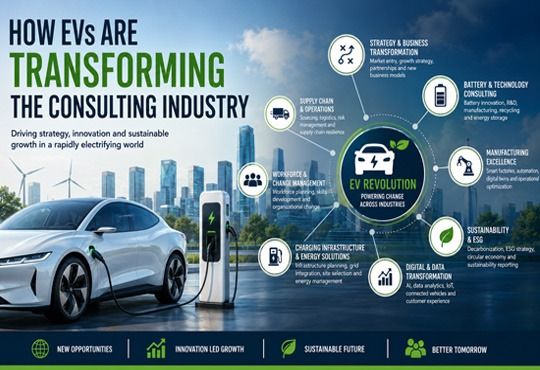
As the EV ecosystem expands, consulting services are no longer limited to traditional business strategy. Today, firms provide expertise in sustainability, supply chain optimization, artificial intelligence, battery technology, manufacturing automation, regulatory compliance, customer experience, cybersecurity, data analytics, mergers and acquisitions, and workforce transformation.
This article explores how the rise of electric vehicles is reshaping the consulting industry, the emerging opportunities, challenges consultants face, and what the future holds.
Electric vehicle adoption has accelerated dramatically over the past decade. Governments worldwide have introduced stricter emission norms, carbon reduction targets, tax incentives, and subsidies to encourage EV adoption. Major automotive manufacturers have committed billions of dollars toward electrification, while startups continue introducing innovative battery technologies and mobility solutions.
Consumers are also becoming increasingly conscious of sustainability, fuel costs, and environmental impact. This changing landscape has created an ecosystem involving:
Each participant requires specialized expertise, creating unprecedented demand for consulting services.
Unlike previous automotive transitions, electrification affects almost every business function simultaneously.
Companies need assistance in areas such as:
Few organizations possess expertise across all these domains.
Consulting firms bridge this knowledge gap by bringing industry insights, cross-sector experience, analytical capabilities, and implementation support.
One of the largest consulting opportunities lies in strategic advisory.
Traditional automakers face difficult questions:
Consultants evaluate market trends, competitor strategies, consumer demand, investment risks, and profitability models to guide executive decision-making.
Similarly, new EV startups rely on consultants to develop business plans, attract investors, optimize operations, and establish scalable business models.
The EV supply chain differs significantly from conventional automobile manufacturing.
Instead of engines and fuel systems, EVs depend heavily on:
Securing these materials has become a strategic priority.
Consultants assist organizations in:
Many consulting firms also use predictive analytics to identify supply chain disruptions before they occur.
Battery technology represents the heart of the EV revolution.
Consultants now advise clients on:
Battery lifecycle management has become a significant consulting niche due to increasing regulatory requirements and sustainability expectations.
EV manufacturing differs substantially from conventional vehicle production.
Factories require:
Consultants help manufacturers modernize plants while minimizing operational disruptions.
Lean manufacturing principles are increasingly combined with Industry 4.0 technologies to improve efficiency and reduce production costs.
Environmental sustainability sits at the center of the EV ecosystem.
Companies increasingly seek guidance on:
Consultants develop sustainability frameworks that align business growth with environmental goals.
Many organizations now consider ESG performance a competitive differentiator rather than merely a compliance requirement.
Electric vehicles are essentially connected computers on wheels.
Modern EVs generate enormous amounts of data regarding:
Consultants help organizations leverage this data for:
Data analytics has become one of the fastest-growing consulting disciplines within the EV ecosystem.
One of the biggest barriers to EV adoption remains charging infrastructure.
Governments and private companies require consulting expertise to determine:
Consultants also conduct feasibility studies for commercial real estate, highways, residential communities, and corporate campuses planning EV charging installations.
The rapid adoption of EVs significantly impacts electricity demand.
Utilities require consulting services to:
Consultants increasingly work with power companies to ensure grid stability while supporting mass EV adoption.
Commercial fleet operators are transitioning toward electric mobility.
Industries include:
Fleet operators seek consulting support for:
Electrifying large fleets involves significant capital investment, making expert consulting invaluable.
The EV industry attracts billions of dollars in investments annually.
Financial consultants assist clients with:
Banks, venture capital firms, private equity investors, and institutional investors increasingly rely on consultants to evaluate EV-related opportunities.
Governments worldwide require expert guidance in developing EV ecosystems.
Consultants assist with:
Consulting firms frequently collaborate with ministries, municipalities, and regulatory agencies to develop long-term mobility strategies.
Connected EVs create new cybersecurity risks.
Potential threats include:
Cybersecurity consultants help manufacturers implement:
As software-defined vehicles become mainstream, cybersecurity consulting will continue expanding.
AI plays an increasingly important role in EV consulting.
Applications include:
Consultants combine AI expertise with automotive knowledge to deliver data-driven recommendations.
Electrification changes workforce requirements.
Companies need professionals skilled in:
Consultants assist organizations with:
Human capital consulting has become increasingly important as traditional automotive roles evolve.
The EV sector faces numerous risks.
These include:
Consultants help organizations identify, assess, and mitigate these risks through comprehensive enterprise risk management frameworks.
Although opportunities are substantial, consultants also face several challenges.
Battery technologies evolve quickly.
Consultants must continuously update their expertise to provide relevant recommendations.
Different countries have varying:
Keeping pace with evolving regulations requires ongoing research.
Demand for EV specialists exceeds supply.
Consulting firms compete intensely for professionals with expertise in battery science, software engineering, energy systems, and sustainability.
Clients increasingly expect consultants to handle confidential operational, manufacturing, and customer data securely.
Strong governance and cybersecurity practices are therefore essential.
The next decade will create additional consulting opportunities in:
Battery Recycling
As first-generation EV batteries reach end-of-life, consultants will advise companies on recycling technologies and circular economy strategies.
Autonomous Electric Mobility
The convergence of EVs and autonomous driving will require expertise in AI governance, safety, and regulation.
Smart Cities
Consultants will integrate EV infrastructure into broader smart-city initiatives involving renewable energy, IoT, and intelligent transportation systems.
Hydrogen Mobility
Many consulting firms are expanding beyond battery-electric vehicles to include hydrogen fuel-cell transportation strategies.
Energy Storage
Second-life EV batteries will support renewable energy storage, creating new consulting markets.
India represents one of the world's fastest-growing EV markets. Government initiatives promoting cleaner transportation, domestic battery manufacturing, and charging infrastructure have accelerated industry momentum.
Consultants are actively supporting Indian organizations in areas such as:
With increasing participation from startups, global automakers, and component manufacturers, consulting demand in India is expected to rise significantly over the coming years.
The consulting industry is entering a new era where mobility, sustainability, digital technologies, and energy systems intersect. Traditional business advisory is evolving into multidisciplinary consulting that combines engineering expertise, digital innovation, regulatory intelligence, and sustainability strategy.
Future consulting engagements will increasingly focus on integrated ecosystems rather than individual business functions. Consultants will help organizations design connected value chains that span battery sourcing, smart manufacturing, renewable energy integration, charging networks, data platforms, and customer-centric mobility services.
Artificial intelligence, digital twins, generative AI, predictive analytics, blockchain for battery traceability, and advanced simulation tools will become standard components of consulting engagements. Firms that invest in specialized EV capabilities, strategic partnerships, and continuous learning will be better positioned to capture long-term growth.
Additionally, collaboration among automakers, technology providers, governments, utilities, financial institutions, and academia will become more important. Consultants will act as facilitators who align stakeholders, manage transformation programs, and ensure that investments deliver measurable business and sustainability outcomes.
The rapid expansion of electric vehicles is reshaping far more than the automotive industry—it is redefining how businesses operate, innovate, and compete. This transformation has positioned consulting firms at the center of one of the world's largest industrial transitions.
From strategic planning and digital transformation to battery innovation, supply chain optimization, sustainability, cybersecurity, workforce development, and public policy, consultants are helping organizations navigate unprecedented technological and operational change. As EV adoption accelerates globally, consulting firms that combine deep industry knowledge with expertise in data, AI, energy systems, and ESG will play an increasingly influential role.
For businesses, partnering with experienced consultants is no longer simply about solving isolated problems. It is about building resilient, future-ready organizations capable of thriving in an electrified economy. The EV revolution is not just changing the vehicles people drive—it is transforming the consulting profession into a critical catalyst for innovation, sustainability, and long-term business success.
We use cookies to ensure you get the best experience on our website. Read more...