
By Tharani Sambu, Content Writer ,

Employee turnover can become a serious challenge for growing businesses. When valuable employees leave, companies can lose experience, productivity, team stability, and time invested in recruitment and training.
This makes employee retention an important priority for businesses looking to build stronger and more sustainable teams.Employees do not always leave because of salary.
Career growth, management, recognition, workplace culture, communication, workload, and opportunities for development can all influence an employee's decision to stay or move on.
For businesses, understanding these factors is important because identifying the real reasons behind employee turnover can help them take the right steps to retain valuable employees.
Employee retention is also closely connected to the overall workplace experience. When employees feel supported, recognized, and able to grow within an organization, they may have stronger reasons to continue their careers with the company.
“There’s no shortage of talent in the market, but the real challenge is ensuring that the right people choose to work with us and stay.” — Madhuri Mehta, CHRO at Emaar India
Her observation highlights an important challenge for businesses: attracting talent is only one part of the equation. Retaining the right employees is equally important. Companies therefore need to look beyond recruitment and focus on creating a workplace where employees feel valued and see opportunities for long-term growth.
This is where HR consultants can provide valuable support. They can assess workforce challenges, identify gaps in HR practices, and help businesses develop practical strategies to improve employee retention.
Employee turnover can have several causes, and the reasons can vary between organizations.
Some employees may leave because they see better career opportunities elsewhere. Others may feel that their contributions are not recognized or that they have limited opportunities to develop their skills.
Management can also have a significant influence on employee experience. When employees do not receive regular feedback, support, recognition, or clear expectations, their engagement can gradually decline.
Workplace culture is another important factor. Poor communication, unresolved conflicts, excessive pressure, limited flexibility, and a lack of recognition can make employees consider other opportunities.
Understanding these factors is the first step toward developing effective employee retention strategies.
HR consultants help businesses reduce employee turnover by identifying workplace issues and creating practical strategies that improve engagement, career growth, management, and overall employee satisfaction.They can also help organizations build a supportive workplace culture, strengthen communication, recognize employee contributions, and create clear opportunities for professional growth. This can give employees stronger reasons to stay and grow within the organization.

HR consultants can help businesses examine employee turnover patterns and identify common reasons employees leave.
They may review employee feedback, exit interviews, workplace policies, compensation structures, management practices, and employee engagement levels.
This gives business leaders a clearer picture of where improvements are needed instead of relying on assumptions.
For example, if exit interviews repeatedly identify limited career growth as a reason for resignation, the company can focus on career-development programs rather than simply increasing recruitment efforts.
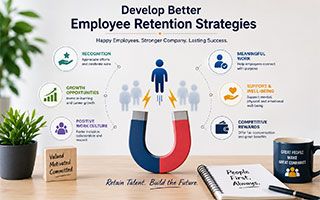
Employee retention requires more than simply increasing salaries.
HR consultants can help businesses develop structured employee retention strategies based on employee needs and business objectives.
These strategies may include recognition programs, career-development opportunities, improved communication, flexible working arrangements, employee feedback systems, professional development, and stronger management practices.
A well-planned retention strategy can help businesses address employee concerns before they result in resignations.

Sometimes employee turnover begins before an employee even joins the company.
Hiring someone whose skills, expectations, or working style do not match the role can lead to dissatisfaction and early resignation.
HR consultants can review recruitment processes, job descriptions, interview methods, candidate evaluation, and onboarding practices to help businesses make better hiring decisions.
A stronger recruitment process can improve the chances of finding employees who are better suited to both the role and the organization's working environment.

Employee engagement plays an important role in retention.
Employees who feel connected to their work and organization are more likely to remain committed to the business.
HR consultants can help businesses identify factors affecting engagement and introduce practical initiatives to improve employee involvement.
Regular feedback, recognition, communication, professional development, and opportunities to contribute ideas can help employees feel more valued. Businesses can also use employee surveys and feedback sessions to understand workplace concerns and identify areas that require improvement.
.jpg "Build Stronger Managers and Leaders")
Employees often interact with their managers more frequently than with senior leadership. This makes managers an important part of the employee experience.
Poor communication, limited support, inconsistent feedback, or ineffective people management can contribute to employee dissatisfaction.
HR consultants can support managers through leadership development, communication training, performance-management frameworks, coaching, and people-management guidance.
Better managers can create a healthier working environment while helping employees understand expectations, receive feedback, and develop professionally.
.jpg "Create Clear Career Development Opportunities")
Employees who cannot see a future within an organization may eventually look elsewhere.
Businesses can address this by providing clear career development opportunities and showing employees how they can progress within the organization.
HR consultants can help create career-development frameworks, training programs, succession plans, mentoring initiatives, and structured performance-review processes.
When employees understand what skills they need to develop and what opportunities may be available to them, they have stronger reasons to consider building their careers within the organization.

Outdated or unclear HR policies can create unnecessary confusion and dissatisfaction.
HR consultants can review areas such as leave policies, performance management, employee communication, workplace conduct, compensation structures, grievance procedures, and workplace practices.
A clear and consistent HR framework can help employees understand organizational expectations while giving managers better processes for handling workplace issues.
Regular policy reviews are particularly important for growing businesses because workforce needs can change as the organization expands.
Improving employee retention can provide benefits beyond simply reducing resignations.
Businesses may experience:
When experienced employees stay longer, businesses can also retain valuable knowledge about customers, processes, projects, and internal operations.
Businesses do not have to wait until employee turnover becomes severe before seeking external HR support.
An HR consultant may be useful when:
An external HR consultant can provide an independent perspective and help management identify workforce issues that may otherwise be overlooked.
Employee retention is not simply about offering higher salaries. Employees also look for opportunities to grow, supportive managers, recognition, fair treatment, meaningful work, and a workplace where they can see a future.
For businesses experiencing high turnover, the first step is to understand why employees are leaving. Once those reasons are clear, companies can take targeted action instead of relying on temporary solutions.
HR consultants can help businesses turn those findings into practical employee retention strategies, stronger HR processes, and better workplace practices.
For growing organizations, investing in employee retention can help protect valuable talent, reduce repeated hiring, and build a more stable workforce.
We use cookies to ensure you get the best experience on our website. Read more...