By Global Consultants Review Team
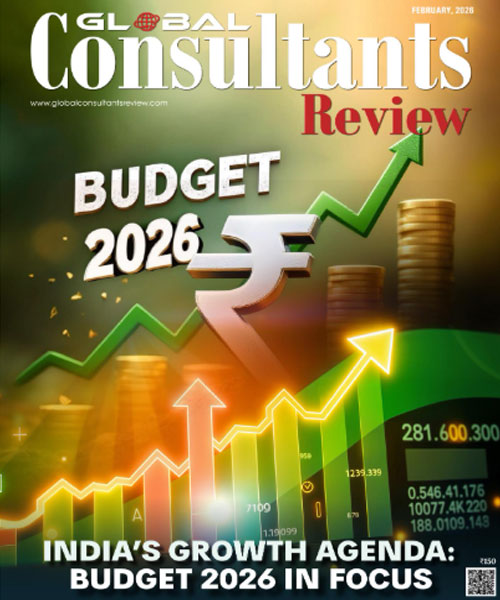
 The Indian Union Budget 2026 marks a decisive shift from short-term stimulus toward long-term structural growth. With a strong emphasis on infrastructure expansion, manufacturing competitiveness, tax simplification, and targeted support for MSMEs and emerging technologies, the budget sets the direction for India’s economic priorities over the coming years. However, for businesses, budget announcements alone do not automatically translate into value. The real challenge lies in interpretation, execution, and alignment with business strategy. This is where consultants play a critical role — transforming policy intent into profitable outcomes.
In a complex and fast-evolving regulatory environment, consultants act as the bridge between government policy and corporate decision-making. By decoding budget provisions, identifying opportunity areas, and enabling implementation, they help organizations move from compliance-driven reactions to strategy-led growth.
Decoding the Budget: Turning Policy Signals into Business Strategy
The Union Budget 2026 introduces reforms that are broad in ambition but nuanced in application. Measures such as the implementation of a new Income Tax framework, continued fiscal discipline, and focused capital expenditure send clear macroeconomic signals. Yet, the impact of these changes varies significantly across industries, company sizes, and operating models.
Consultants add value by translating these macro-level signals into firm-specific insights. For large corporations, this may involve reassessing tax structures, supply chains, and investment timelines in light of regulatory simplification and improved ease of doing business. For MSMEs, it often means understanding eligibility, documentation, and compliance requirements tied to newly announced funding mechanisms and liquidity support measures.
Beyond interpretation, consultants help leadership teams contextualize budget changes within their broader strategic goals. Rather than treating the budget as a standalone annual event, advisors help clients see it as part of a multi-year policy trajectory. This strategic framing enables businesses to make informed decisions on capacity expansion, capital allocation, and market entry while staying aligned with government priorities.
Identifying and Capturing Budget- Driven Opportunities
One of the most significant aspects of the 2026 Budget is its emphasis on public investment-led growth. Increased allocation toward infrastructure, logistics, and industrial corridors opens new avenues for companies across construction, manufacturing, transportation, and ancillary services. However, participation in these opportunities often requires preparedness — from meeting qualification criteria to navigating tendering and partnership models.
Consultants help clients assess where they fit within this expanding ecosystem. This includes identifying relevant opportunities, evaluating competitive positioning, and designing go-to-market strategies aligned with government-led projects. For companies in technology and advanced manufacturing, budget incentives linked to electronics, semiconductors, and innovation-driven sectors offer potential for accelerated growth. Consultants support these firms by mapping incentives to capability gaps, structuring collaborations, and planning phased investments.
The budget’s focus on export facilitation and reduced friction for service-based industries also presents opportunities for global expansion. Consultants assist businesses in optimizing operating models, managing regulatory risk, and aligning cross-border structures to leverage these policy shifts effectively. In each case, the consultant’s role is not just advisory but deeply analytical — ensuring opportunities are prioritized based on feasibility, return on investment, and organizational readiness.
Execution, Compliance, and Long- Term Value Creation
Policy benefits are only realized when execution is disciplined. Budget 2026 introduces changes that require businesses to adapt internal processes, particularly in taxation, reporting, and compliance. Consultants support this transition by helping organizations redesign workflows, upgrade systems, and train internal teams to operate efficiently under new regulations.
Effective execution also involves managing risk. Transitional phases following new legislation often carry compliance uncertainty and potential exposure. Consultants help clients anticipate these challenges, put controls in place, and establish monitoring mechanisms that ensure benefits are captured without unintended consequences.
More importantly, the most impactful consultants help clients look beyond immediate budget gains toward long-term value creation. The 2026 Budget places renewed emphasis on human capital development, digital transformation, and sustainability-linked growth. By aligning talent strategies, digital investments, and ESG initiatives with these priorities, businesses can build resilience while strengthening their market positioning.
Rather than chasing short-lived incentives, consultants encourage organizations to embed budget-aligned thinking into their long-term strategy. This approach ensures that policy changes become catalysts for sustainable growth rather than temporary boosts.
Consultants as Catalysts of Budget- Led Growth
The Indian Union Budget 2026 sets a clear direction for economic development, but its true impact depends on how effectively businesses respond. Consultants play a pivotal role in this journey — helping organizations move from policy awareness to strategic action. By decoding reforms, identifying opportunities, enabling execution, and aligning long-term strategy with government priorities, consultants transform policy into profit.
In an environment where regulatory clarity and competitive advantage are closely linked, those who can interpret and operationalize budget changes will shape the next phase of India’s growth story.
We use cookies to ensure you get the best experience on our website. Read more...