
By Global Consultants Review Team
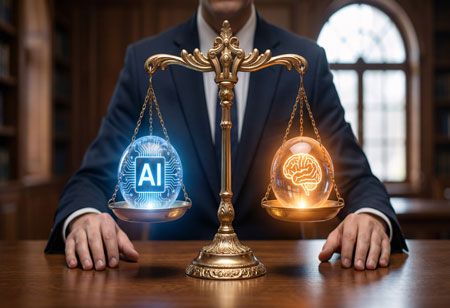
Artificial intelligence has rapidly become a core capability in consulting. From financial modeling and market analysis to scenario planning and risk assessment, AI systems now deliver insights in minutes that once took teams weeks to produce. As these tools become widely accessible, a critical question emerges: if everyone has AI, what truly differentiates great consultants from the rest?
The answer lies beyond algorithms. While AI excels at processing information, identifying patterns, and optimizing known variables, great consulting has never been about analysis alone. It has always been about judgment - the uniquely human ability to interpret context, balance competing interests, and make decisions under uncertainty.
AI Solves for Speed and Scale - Not Meaning
AI is exceptionally good at answering 'what' and 'how.' It can analyze vast datasets, benchmark performance, forecast outcomes, and surface correlations that humans might miss. In finance and strategy consulting, this dramatically improves speed, accuracy, and consistency. Tasks that once defined junior and mid-level consulting work are now automated or augmented.
However, AI does not understand why an organization behaves the way it does. It cannot fully grasp internal politics, cultural resistance, leadership egos, or the unspoken constraints that shape decision-making. It may recommend a cost-cutting initiative that looks optimal on paper, but fails to recognize its impact on morale, brand reputation, or long-term capability building.
Consulting value emerges not from producing the 'right' answer, but from delivering the right answer for that organization, at that moment. That distinction requires human judgment.
Judgment Thrives Where Data Ends
The most critical consulting decisions are made in conditions of incomplete information. Mergers happen under time pressure. Turnarounds unfold amid uncertainty. Geopolitical risk, regulatory shifts, and competitive disruptions rarely come with clean datasets.
Human judgment fills the gap where data runs out. Experienced consultants draw on intuition shaped by pattern recognition, lived experience, and exposure to failure as much as success. They sense when a client is not ready for a transformation, when a recommendation needs to be phased, or when alignment matters more than speed.
AI can simulate scenarios, but it cannot take responsibility for consequences. Judgment involves accountability - owning the trade-offs and standing by a recommendation when outcomes are uncertain.
Trust is the New Currency of Consulting
In an AI-driven world, information asymmetry is shrinking. Clients can access the same tools, dashboards, and models as consultants. What they cannot automate is trust.
Trust is built through credibility, empathy, and the ability to challenge leaders constructively. It is earned when consultants listen deeply, ask uncomfortable questions, and translate complex insights into decisive action. Senior executives do not hire consultants just to validate data; they hire them to help make hard calls that carry personal and organizational risk.
In the end, AI may transform how consulting is delivered, but it will not replace why it exists. Great consulting has always been about helping organizations make better decisions. And as long as decisions involve people, power, risk, and responsibility, human judgment will remain the defining edge.
We use cookies to ensure you get the best experience on our website. Read more...