
By Global Consultants Review Team ,
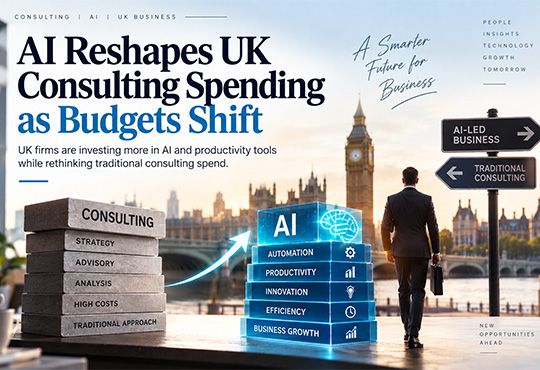
UK businesses are beginning to rethink how they spend on professional services as artificial intelligence becomes a more practical tool for solving business problems.
New data reported by City A.M. on September 8, 2026, shows that median spending on consulting fees fell 1.9% year on year in August, even as overall corporate spending increased 2.2%.
The figures come from the Business Spend Pulse, which tracks millions of transactions from more than 300,000 UK businesses using Capital on Tap cards.
The latest data points to a change in corporate priorities, with businesses increasingly investing in AI and productivity tools while some traditional professional-services spending comes under pressure.
One of the strongest signals in the latest figures is the growth in business spending on AI providers. The proportion of businesses paying for AI companies such as Anthropic and ElevenLabs has increased from approximately one in 13 last year to one in seven this year.
The shift suggests that businesses are becoming more comfortable using AI for tasks that previously required additional external support. Research, analysis, content creation, automation and other routine activities can increasingly be handled through AI-powered tools.
However, rising AI adoption does not necessarily mean companies are abandoning consultants. Instead, it may change the type of work businesses expect consulting firms to deliver.
The latest Business Spend Pulse data shows consulting expenditure facing pressure as businesses reassess their professional-services budgets. Professional services have also declined as a share of overall business expenditure, pointing to a broader shift in where companies are allocating resources.
The change comes as businesses look for faster and more measurable returns from their investments. Rather than relying entirely on external advice, companies can now experiment with AI tools that provide analysis, automation and operational support.
“Businesses still spent a little more than they did a year ago, and they are putting that money into the tools that make them more productive.” - Damian Brychcy, CEO of Capital on Tap.
His comment highlights an important point: businesses are not simply cutting expenditure. They are becoming more selective about where their money can generate productivity gains.
The shift extends beyond AI subscriptions. Businesses are also directing spending towards equipment, tools and other resources that can directly support productivity.
For consulting firms, this creates a new challenge. Clients may increasingly expect consultants to demonstrate not only strategic expertise but also how their recommendations can translate into measurable improvements.
The traditional consulting model of delivering advice and recommendations is therefore being tested by technology that can provide businesses with faster access to information and analysis.
The growing use of AI also raises another important question : Can technology solve a business problem if the underlying process itself is inefficient?
Ajay Prakash, Managing Director at Straveo, highlighted this issue in a Financial Times letter. His observation is particularly relevant as companies accelerate AI adoption.
“AI can make processes cheaper and faster, but it doesn’t necessarily fix the underlying problem.” — Ajay Prakash, Managing Director, Straveo
The point is important for the consulting industry. AI can accelerate an existing process, but businesses still need to determine whether that process is effective in the first place.
This creates an opportunity for consultants to focus on areas such as process redesign, operating-model transformation and identifying the right problems to solve before technology is introduced.
AI adoption is particularly strong in London. Recent data shows that around one in five London businesses are paying for AI services, placing the capital among the UK's leading centres for business AI adoption.
Other UK cities are also recording significant levels of adoption, suggesting that AI is moving beyond technology-focused companies and becoming part of wider business operations.
For consulting firms, this geographic expansion could create demand for specialists who can help businesses identify appropriate AI use cases, manage implementation and integrate new tools with existing systems.
The latest spending figures present a mixed picture for the consulting industry.
Traditional consulting expenditure is facing pressure as companies become more comfortable using internal teams and AI tools. At the same time, businesses still require specialist expertise for complex transformation, technology implementation, organisational change and strategic decision-making.
The result could be a shift from advice-led consulting towards implementation-focused consulting.
Consulting firms may increasingly need to help clients select AI solutions, redesign processes, implement technology and measure the results rather than simply provide strategic recommendations.
The changing spending pattern could accelerate the consulting industry's transition towards technology-enabled implementation.
Businesses may use AI for research, routine analysis and automation while turning to consultants for more complex questions:
These questions require more than simply purchasing an AI platform.
Consultants could increasingly serve as the bridge between AI technology and business execution, helping organisations move from experimentation to practical implementation.
The latest UK spending data does not necessarily signal the end of consulting. Instead, it points towards a changing relationship between businesses, consultants and artificial intelligence.
Companies can increasingly use AI for tasks that once required significant external support. Consultants, meanwhile, may need to focus more heavily on areas where human judgement, industry expertise and transformation experience remain important.
This could result in a consulting market where technology handles more routine work while consultants concentrate on complex business decisions and implementation.
The September 8 data provides an important signal for the UK consulting industry. Businesses are continuing to spend, but they are becoming more selective about where their budgets go.
AI and productivity tools are receiving greater attention, while traditional consulting expenditure is facing pressure. For consulting firms, the response may not be to compete with AI but to adapt alongside it.
Firms that can combine strategic advice, process improvement, AI implementation and measurable business outcomes could be better positioned as clients rethink their professional-services budgets.
The emerging question for UK businesses is therefore no longer simply whether they need consultants or AI. It is increasingly about how human expertise and AI can work together to solve the right business problems.
We use cookies to ensure you get the best experience on our website. Read more...