

By Global Consultants Review Team ,
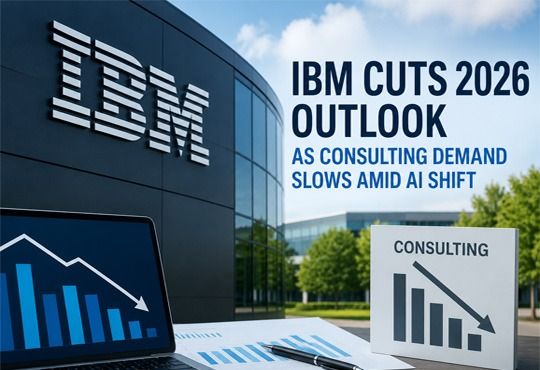
IBM has revised its full-year 2026 revenue outlook after reporting weaker-than-expected second-quarter results, with its consulting business emerging as one of the primary areas of concern. The announcement has drawn attention across the consulting industry, highlighting how enterprise spending patterns are shifting in the age of artificial intelligence.
The company reported quarterly revenue of approximately $17.2 billion, slightly below market expectations. While IBM's software division continued to post steady growth and AI-related bookings remained strong, consulting revenue remained largely flat as several enterprise clients delayed large-scale transformation projects.
According to IBM CEO Arvind Krishna, many organizations are redirecting technology budgets toward AI infrastructure and foundational investments before committing to broader consulting-led transformation initiatives. This has resulted in slower consulting deal closures during the quarter, although IBM indicated that several delayed projects have already begun moving forward in the current quarter.
The results illustrate a broader trend affecting the consulting sector. Clients are becoming more selective with consulting expenditures, prioritizing measurable AI implementations over long-term advisory engagements. Rather than commissioning extensive digital transformation programs, enterprises increasingly seek consultants capable of delivering rapid AI deployment, automation, governance, and business outcomes.
IBM emphasized that demand for generative AI solutions remains healthy. The company continues to win AI-related engagements, particularly in hybrid cloud, automation, and enterprise AI adoption. However, the pace of converting these opportunities into consulting revenue has moderated as customers reassess capital allocation.
IBM's performance mirrors a broader challenge facing global consulting firms. Technology consultants are adapting their business models as clients expect faster implementation, outcome-based pricing, and greater use of AI within consulting engagements themselves. Traditional advisory work is increasingly complemented by AI engineering, automation services, and managed AI operations.
Industry analysts believe consulting firms that combine strategic advisory with hands-on AI execution will be better positioned for long-term growth. Firms are investing heavily in proprietary AI platforms, workforce upskilling, and industry-specific AI accelerators to remain competitive.
Despite lowering its revenue forecast, IBM maintained confidence in its long-term AI strategy and reaffirmed its free cash flow guidance. The company expects consulting demand to improve as delayed enterprise projects move into execution and organizations progress from AI experimentation to enterprise-scale deployment.
For the consulting industry, IBM's latest results reinforce a key reality: success will increasingly depend not only on strategic advice but also on the ability to deliver measurable AI-driven business transformation.
We use cookies to ensure you get the best experience on our website. Read more...