

By Global Consultants Review Team ,
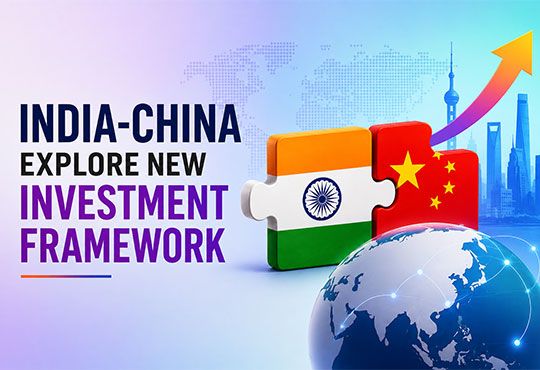
India and China are exploring a new framework to strengthen business-to-business exchanges and accelerate investment flows, signalling a cautious revival in commercial ties between the two Asian economies.
The development comes as relations between New Delhi and Beijing show signs of improvement following years of diplomatic and economic tensions. According to people familiar with the discussions cited by The Economic Times, the two countries are examining ways to make investment and business engagement easier, particularly in non-strategic sectors.
The discussions could gain further momentum during Chinese President Xi Jinping’s expected visit to India for the BRICS Summit on September 12–13. Reports suggest Beijing could potentially announce an investment package for India during the visit, including proposals for a special economic zone with improved access to sea routes. However, Xi’s visit and the proposed investment package have not been formally confirmed by both governments.
The proposed investment framework comes after several steps aimed at rebuilding economic engagement between the two countries.
India revised its foreign investment rules earlier this year, allowing certain non-controlling investments from entities linked to countries sharing a land border with India to enter through the automatic route, subject to conditions and sectoral restrictions. The policy change represents a calibrated easing of restrictions introduced after the 2020 border crisis.
The impact is already becoming visible. India has received 29 FDI proposals worth ₹4,895.65 crore, or about $511.5 million, under the revised framework. The proposals cover sectors including information technology, artificial intelligence, manufacturing, pharmaceuticals, data centres and transport.
For businesses, the changes could provide greater clarity around investment structures while allowing India to retain safeguards around strategic and sensitive sectors.
Despite the improving economic relationship, the border issue continues to play a major role in determining the pace of normalisation.
India’s National Security Adviser Ajit Doval, who is also the Special Representative for the India-China boundary talks, met Chinese Foreign Minister Wang Yi in Beijing on August 25.
“The normalcy in our relationship has been a direct result of both sides maintaining peace and tranquility in the border areas.” - Ajit Doval , India’s National Security Adviser
During the meeting, Doval highlighted the connection between border stability and broader bilateral relations. He also said that the state of the border, to a very large measure, naturally would determine the state of the relations.
The remarks underline an important condition for deeper economic engagement sustained peace and stability along the India-China border.
The emerging of investment framework could potentially create easier channels for business-to-business engagement and investment while maintaining restrictions in strategically sensitive areas.
Reports indicate that discussions may focus on sectors where Chinese investment can support India's manufacturing and industrial ambitions without creating national-security concerns. Areas such as technology, manufacturing, supply chains, electric vehicles and industrial infrastructure could attract greater attention.
For China, greater access to the Indian market could provide opportunities for companies seeking long-term growth in one of the world's fastest-growing major economies.
For India, Chinese capital and industrial expertise could help strengthen manufacturing capacity, supply chains and technology access, while increased exports to China could help address the bilateral trade imbalance.
The potential revival of India-China investment could also create opportunities for the consulting industry.
Companies entering a new market typically require support with market-entry strategy, regulatory compliance, investment structuring, due diligence, supply-chain planning and geopolitical risk assessment.
Consulting firms could therefore play an important role in helping Indian and Chinese companies understand regulatory requirements and manage the risks associated with cross-border investments.
For M&A advisers, the development could also become significant if greater investment flows eventually lead to more joint ventures, strategic partnerships, minority investments and acquisitions between companies from the two countries.
The opportunity, however, will depend heavily on how quickly diplomatic and regulatory confidence improves.
The expected BRICS Summit in New Delhi could provide an important platform for India and China to discuss the next stage of their economic relationship.
If Xi Jinping attends, a meeting with Prime Minister Narendra Modi could potentially provide momentum to discussions on investment, trade and broader business engagement. Xi's participation has been widely expected, although it has not yet been formally confirmed.
The timing is significant because both countries are attempting to move beyond the economic disruption that followed the 2020 border crisis while continuing to manage unresolved strategic differences.
For companies and investors, the key question is whether the current diplomatic thaw translates into actual investment commitments.
For consulting firms, these developments could create a new demand cycle around cross-border strategy, regulatory advisory, risk consulting and M&A services.
India-China economic engagement is therefore moving into a potentially important phase. The proposed investment framework is still under discussion, but the combination of relaxed investment rules, renewed diplomatic dialogue and possible high-level engagement at the BRICS Summit could mark an important step toward rebuilding business ties.
For now, the opportunity is significant—but its success will depend on whether improved diplomatic relations can translate into sustained commercial confidence.
We use cookies to ensure you get the best experience on our website. Read more...