

By Global Consultants Review Team ,
 A new U.S. immigration rule is set to increase costs for certain employers that rely heavily on H-1B and L-1 workers, creating another challenge for Indian IT and consulting companies with employees working in the United States.
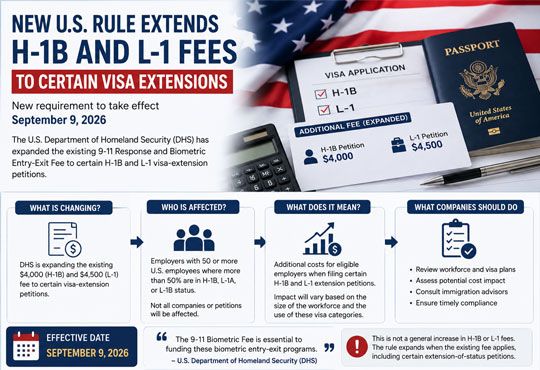
The U.S. Department of Homeland Security (DHS) has finalized a rule expanding the existing 9-11 Response and Biometric Entry-Exit Fee to certain H-1B and L-1 visa-extension petitions. The rule will take effect on September 9, 2026.
The development is drawing attention in India's technology and consulting sectors because many companies operate across India and the U.S. and use these visa categories to support skilled professionals working on international projects.
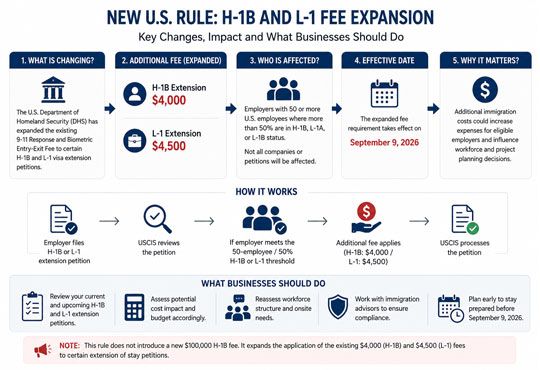
Under the new rule, eligible employers will have to pay an additional $4,000 for H-1B petitions and $4,500 for L-1 petitions covered by the requirement.
The rule applies to employers with 50 or more employees in the United States where more than 50% of their workforce is in H-1B, L-1A or L-1B status. Not every company or every visa petition will be affected.
The important point is that the government is not simply increasing the existing $4,000 and $4,500 amounts. Instead, DHS is expanding the circumstances in which the existing fee applies, including certain extension-of-status petitions for employees who remain with the same employer.
DHS said the rule is intended to align its regulations with congressional requirements and support the country's biometric entry and exit programs.
“The 9-11 Biometric Fee is essential to funding these biometric entry-exit programs.” — U.S. Department of Homeland Security
Indian IT services and consulting companies have a significant presence in the U.S. market. Many operate with teams distributed across different countries, making immigration policy an important part of workforce planning.
For companies that meet the requirements, the additional fee could increase the cost of extending the stay of eligible employees in the United States.
The financial impact will vary. Companies with a large proportion of employees working under H-1B and L-1 status are more likely to feel the effect than businesses with limited use of these visa categories.
The change could encourage affected companies to take a closer look at their international staffing strategies.
For IT and consulting firms, decisions about where employees are based depend on several factors, including client requirements, project timelines, availability of specialized skills, operating costs and immigration regulations.
An additional visa-related expense could become another factor when companies decide whether certain roles need to be performed directly in the U.S. or whether some work can be delivered from offshore locations.
Companies may also review their visa portfolios and workforce plans before the new requirement takes effect.
The significance of the rule goes beyond the immigration department of a company.
Consulting and technology projects often depend on specialized professionals who work closely with clients. If immigration costs change, companies may need to reconsider project staffing, employee mobility and operating expenses.
This could increase the importance of workforce planning, immigration advisory and compliance services for companies with large international teams.
For consulting firms, understanding regulatory changes can become part of helping clients manage the wider business impact of international operations.
It is also important to understand what this rule does not mean.
The latest development should not be described simply as a blanket increase in H-1B and L-1 visa fees. The $4,000 H-1B and $4,500 L-1 amounts are existing statutory fees. The new rule expands their application to additional qualifying extension petitions.
This distinction matters for businesses trying to estimate the actual impact of the change.
The expanded fee requirement will become effective on September 9, 2026. Covered employers will have time to review their visa and workforce plans before the new rules take effect.
For India's IT and consulting industry, the development is another reminder that U.S. immigration policy can have a direct impact on business operations.
As companies continue to manage international talent and deliver services across borders, immigration rules are becoming an increasingly important part of workforce planning, project management and international business strategy.
For businesses operating between India and the United States, keeping track of these changes will be important as they plan their staffing and consulting operations for the months ahead.
We use cookies to ensure you get the best experience on our website. Read more...