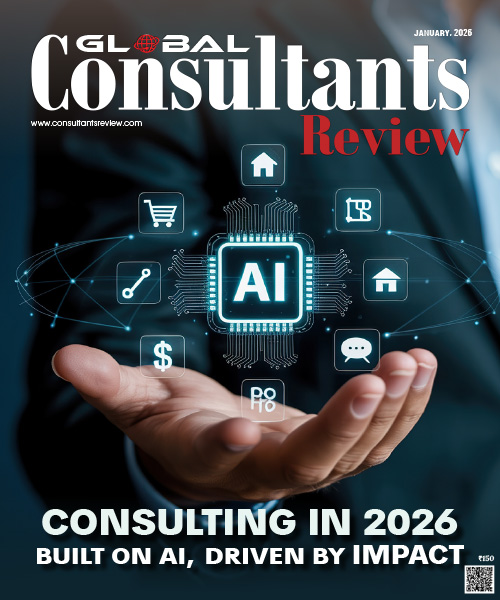

By Riddhi D, Senior Correspondent

Riddhi D, Senior Correspondent
For decades, businesses turned to consultants for answers. Today, artificial intelligence is forcing the consulting industry to confront an uncomfortable question: What happens when expertise becomes available to everyone?
When ChatGPT reached 100 million users in record time, most industries viewed it as another technological disruption.
Consulting saw something different.
It saw a potential competitor.
For more than a century, consulting firms have built their business models around a simple premise. Organizations face complex problems. Consultants bring expertise, frameworks, research, and recommendations. Clients pay premium fees for insights they cannot easily obtain elsewhere.
The model created one of the world's most profitable professional services industries. Today, management consulting is estimated to generate more than $1 trillion globally, spanning strategy, operations, technology, risk management, human capital, and digital transformation.
Yet artificial intelligence is beginning to challenge some of the very activities that consultants have traditionally monetized.
Market analysis.
Competitive research.
Benchmarking.
Financial modeling.
Presentation development.
Data interpretation.
Tasks that once required teams of analysts working for weeks can increasingly be completed in hours.
The question facing the industry is no longer whether AI will affect consulting.
The question is how much of consulting remains uniquely human.
A Profession Built on Knowledge
Historically, consulting firms thrived because knowledge was scarce.
When a CEO needed to understand a new market, evaluate a merger, redesign an operating model, or enter a foreign country, there were limited sources of reliable expertise.
Firms such as McKinsey & Company, Boston Consulting Group, Bain & Company, Accenture, Deloitte, PwC, EY, and KPMG became trusted advisors precisely because they possessed information, methodologies, and experience that clients lacked.
The value proposition was clear.
Consultants knew something others did not.
Artificial intelligence is changing that equation.
Today, generative AI systems can summarize industries, analyze reports, identify trends, compare competitors, and produce strategic recommendations within seconds.
While these outputs are not perfect, they are improving at a pace few anticipated.
For the first time, access to information is becoming democratized at scale.
And that creates a dilemma.
If knowledge becomes abundant, what exactly are clients paying consultants for?
The End of the PowerPoint Era?
Few professions are more associated with presentations than consulting.
The stereotype of consultants spending late nights refining PowerPoint decks exists for a reason.
For years, the ability to synthesize large amounts of information into clear executive recommendations represented a valuable skill.
Today, AI tools can generate presentations, summarize documents, build reports, and create visualizations almost instantly.
This does not mean consultants will disappear.
But it does mean that some traditional consulting activities are rapidly becoming commodities.
Industry experts increasingly argue that clients will become less willing to pay premium fees for deliverables that technology can generate at a fraction of the cost.
As one managing partner of a global consulting firm recently observed, “Clients are no longer buying slides. They are buying confidence.”
That distinction may define the industry's future.
Why Trust Still Matters
Despite AI's growing capabilities, consulting has never been solely about information.
Executives rarely hire consultants because they cannot access data.
They hire consultants because important decisions carry risk.
A CEO contemplating a billion-dollar acquisition does not simply need information.
They need confidence.
They need independent perspectives.
They need experienced advisors capable of navigating uncertainty, organizational politics, stakeholder concerns, and implementation challenges.
AI can provide analysis.
It cannot yet sit across from a board of directors and build trust.
It cannot negotiate conflicting interests between business units.
It cannot persuade employees to embrace change.
It cannot manage the human dynamics that often determine whether transformation succeeds or fails.
This is why many industry leaders believe AI will not eliminate consulting.
Instead, it will redefine what clients value.
The Rise of the AI-Augmented Consultant
The most successful consulting firms are not resisting AI.
They are integrating it.
Across the industry, firms are investing billions in proprietary AI platforms, knowledge systems, and digital assistants designed to improve productivity.
Tasks that once required teams of junior analysts can increasingly be completed through AI-assisted workflows.
Research cycles are shrinking.
Proposal development is accelerating.
Knowledge management is becoming more sophisticated.
The implications are significant.
Traditionally, consulting firms relied on pyramid-shaped organizational structures, with large numbers of junior consultants supporting smaller groups of senior leaders.
AI may fundamentally alter that model.
If technology can automate much of the analytical work historically performed by junior staff, firms may require fewer analysts and more specialized advisors.
The future consultant could look very different from the consultant of the past.
A Talent Crisis in Disguise
While AI promises efficiency, it also creates a talent challenge.
Consulting firms have traditionally used entry-level roles as training grounds.
Junior consultants learned through research, data gathering, analysis, and project support.
Over time, they developed the judgment necessary to advise senior executives.
But what happens if AI automates many of those learning experiences?
Some industry observers worry that firms could inadvertently weaken their leadership pipelines.
Future partners are not created overnight.
They develop through years of exposure to client challenges.
If foundational experiences disappear, firms may struggle to cultivate the next generation of advisors.
The industry has faced technological disruptions before.
This time, however, the disruption directly affects how consultants learn their craft.
New Opportunities Beyond Efficiency
While much attention focuses on automation, AI is also creating entirely new consulting opportunities.
Organizations worldwide are struggling with questions surrounding AI governance, implementation, cybersecurity, ethics, workforce transformation, and regulatory compliance.
Boards want answers.
Executives need roadmaps.
Governments seek guidance.
In response, AI advisory services have become one of the fastest-growing segments of the consulting industry.
Rather than reducing demand for consultants, AI may ultimately generate new forms of demand.
The winners will be firms capable of helping clients navigate technological transformation rather than simply analyzing it.
The Future Belongs to Judgment
The consulting industry was never truly about information.
Information was simply the vehicle through which value was delivered.
The real product has always been judgment.
Judgment requires context.
Judgment requires experience.
Judgment requires understanding not only what can be done but what should be done.
Artificial intelligence can process vast amounts of information.
It can identify patterns, generate options, and accelerate analysis.
What it cannot fully replicate is the human ability to balance competing priorities, navigate ambiguity, and build consensus among stakeholders.
Those capabilities remain central to leadership—and increasingly central to consulting.
A Defining Moment for the Industry
Every generation of consultants faces a transformational challenge.
Previous generations confronted globalization, digital transformation, outsourcing, and economic crises.
Today's generation faces artificial intelligence.
Some firms will treat AI as a productivity tool.
Others will redesign their business models around it.
The most successful organizations will likely recognize a simple reality.
Clients are not paying for information.
They are paying for outcomes.
As AI continues to reshape professional services, the firms that thrive will not be those that protect old ways of working.
They will be the ones that redefine consulting itself.
The consultant's dilemma is not whether AI will change the industry.
That question has already been answered.
The real question is whether consulting firms can evolve faster than the technology transforming their profession.
We use cookies to ensure you get the best experience on our website. Read more...