
By Global Consultants Review Team ,
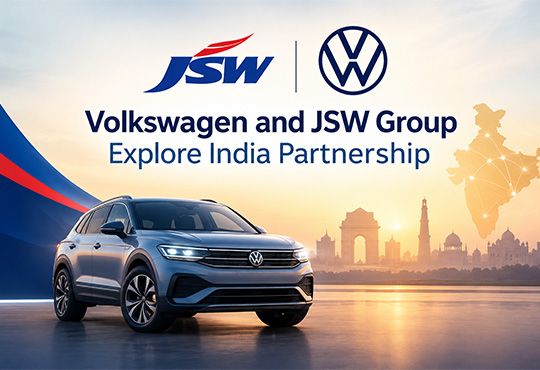
Volkswagen Group and JSW Group are moving closer to a strategic partnership in India after signing a non-binding Memorandum of Understanding (MoU) to explore a proposed joint venture covering Volkswagen’s passenger-vehicle operations in the country. The development marks an important step in Volkswagen’s efforts to strengthen its position in India’s competitive automotive market.
The proposed alliance is being discussed around a 51:49 ownership structure, with JSW Group expected to hold 51% and Volkswagen Group 49%. The MoU begins exclusive negotiations covering valuation, tax liabilities, governance and other transaction details.
The two companies are targeting a final binding agreement by the end of 2026. Until that agreement is signed, the proposed joint venture should not be treated as a completed transaction.
The proposed partnership could involve joint control, defined operational responsibilities and governance mechanisms designed to support faster decision-making. The companies are also expected to explore greater local sourcing, vehicle-platform sharing and expanded production capacity.
Volkswagen has operated in India for more than two decades, but its market share remains around 2%. The company is therefore looking for ways to improve scale, competitiveness and profitability in one of the world's largest automotive markets.
A partnership with JSW could help Volkswagen combine its global automotive technology and vehicle platforms with JSW’s understanding of the Indian market, local manufacturing capabilities and investment strength.
Klaus Zellmer, CEO of Škoda Auto, previously highlighted the value of working with a strong local partner:
“I’m deeply convinced that our momentum can be much stronger if we have a local partner with strong roots.” — Klaus Zellmer, CEO, Škoda Auto
His earlier comments provide context for Volkswagen’s search for a local partner in India.
For JSW Group, the proposed Volkswagen alliance would strengthen its expanding presence in the passenger-vehicle industry.
JSW entered India’s passenger-vehicle market through JSW MG Motor India, its joint venture with SAIC Motor. The group has been increasing its focus on electric vehicles, manufacturing capacity and automotive localisation.
Parth Jindal, Managing Director at JSW Paints and JSW Cement and Director at MG Motor India, previously described JSW’s automotive entry as a major consumer-business expansion:
“The new venture will be JSW Group's biggest-ever consumer foray and a multi-billion-dollar bet on electric and new energy vehicles.” — Parth Jindal, Managing Director, JSW Paints & JSW Cement; Director, MG Motor India
His comments highlight the scale of JSW’s automotive ambitions and its broader focus on electric and new-energy mobility.
One of the key areas of the proposed Volkswagen-JSW collaboration is localisation.
The companies are expected to explore greater local sourcing, shared vehicle platforms and increased production capacity. These measures could help reduce manufacturing costs and make Volkswagen’s operations more competitive in India.
For Volkswagen, deeper localisation could also support the development of vehicles specifically suited to Indian consumers while creating opportunities to use India as a manufacturing and export base.
For JSW, the partnership could provide access to Volkswagen’s global technology, platforms and automotive expertise.
Volkswagen brings decades of global automotive experience, established vehicle platforms and a broad portfolio of brands and technologies.
The proposed partnership could allow the German automaker to use these capabilities more effectively in India while sharing investment and operational responsibilities with a strong domestic partner.
The collaboration could also support future electric-vehicle development as global automakers increasingly shift investment toward EVs and other new-energy technologies.
JSW offers strong experience across large-scale manufacturing, infrastructure and investment, along with its growing automotive presence in India.
Its existing involvement with MG Motor India gives the group experience in passenger vehicles and local market operations. This could help Volkswagen navigate India’s highly competitive and price-sensitive automotive market.
The proposed structure would therefore combine Volkswagen’s global automotive capabilities with JSW’s local market strength and investment capacity.
The proposed partnership comes at an important time for both groups.
For Volkswagen, the alliance could provide a path to greater scale, stronger localisation and improved competitiveness in India. For JSW, it could accelerate its ambitions to become a larger player in the passenger-vehicle and electric-mobility sectors.
The deal also reflects a broader trend in India’s automotive industry: global automakers are increasingly looking for local partnerships to share investment, improve localisation and respond faster to changing consumer demand.
The current agreement is only a non-binding MoU. Volkswagen and JSW still need to negotiate important commercial and legal matters before a final transaction can be completed.
The companies are now entering exclusive negotiations, with valuation, tax liabilities, governance and other transaction terms still to be finalized. The target is to reach a binding agreement by the end of 2026.
If finalized, the Volkswagen-JSW joint venture could become a significant development for India’s automotive industry.
It could bring additional investment into manufacturing, encourage higher local sourcing, expand production capacity and potentially strengthen India’s position as an automotive export hub.
For Volkswagen, India could become an increasingly important growth market outside its traditional strongholds. For JSW, the partnership could represent another major step in building a diversified automotive business.
The Volkswagen-JSW discussions are now moving from exploratory talks toward a more structured negotiation process. While the final joint venture is still subject to agreement on key terms, the proposed 51:49 structure and non-binding MoU signal serious intent from both companies.
If successfully completed, the partnership could reshape Volkswagen’s India strategy while giving JSW a stronger position in the country’s rapidly evolving passenger-vehicle market.
We use cookies to ensure you get the best experience on our website. Read more...