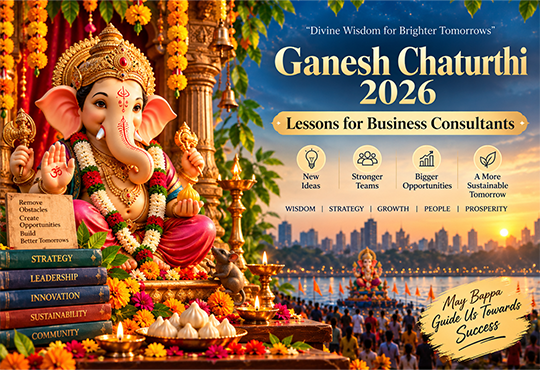
Ganesh Chaturthi 2026 will be celebrated on September 14, bringing communities together across India to celebrate Lord Ganesha, the symbol of wisdom, prosperity, new beginnings and the removal of obstacles.
While the festival has deep religious and cultural significance, it also creates a large and interconnected business ecosystem.
From idol makers and flower sellers to retailers, caterers, transport providers, event organizers, tourism businesses and digital platforms, many businesses experience increased activity around the celebration.
It provides practical lessons in strategic planning, leadership, consumer behavior, problem-solving, adaptability, community engagement and sustainability.
Why Is Ganesh Chaturthi Celebrated?
Ganesh Chaturthi celebrates the birth of Lord Ganesha. The festival is observed through the installation of Ganesha idols in homes and public spaces, prayers, cultural programs, community gatherings and finally the immersion of idols during Ganesh Visarjan.
The celebration has evolved into a significant community activity in many parts of India. Public celebrations require coordination among organizers, local authorities, volunteers, artists, suppliers, businesses and residents.
From a consulting perspective, this makes Ganesh Chaturthi an interesting example of large-scale coordination and ecosystem management.
Businesses also respond to changing demand during the festival. Consumers purchase traditional food, flowers, decorations, clothing, gifts, travel services and other products. This creates opportunities for both established companies and small
local businesses.
 Ganesh Chaturthi Creates a Large Business Ecosystem
The commercial activity surrounding Ganesh Chaturthi extends across several sectors.
A single celebration can connect artisans, suppliers, retailers, transport providers, caterers, decorators, event companies and
digital businesses.
According to a September 2024 announcement from the Confederation of All India Traders (CAIT), the organization estimated that Ganesh Chaturthi would generate more than ₹25,000 crore in business activity that year.
The figure relates specifically to 2024 and should not be treated as a 2026 forecast.
CAIT Secretary General Emeritus Praveen Khandelwal highlighted the wider economic significance of the festival
"Ganesh Chaturthi drives significant economic activity particularly in regions like Maharashtra, Karnataka, Gujarat, Andhra Pradesh, Telengana, Madhya Pradesh, Tamil Nadu and Goa establishing the significance and contribution of Sanatan Economy in the country.” — Praveen Khandelwal, Secretary General Emeritus, Confederation of All India Traders (CAIT)
For consultants, the important lesson is the ecosystem behind this activity.
An idol maker depends on suppliers. A decorator depends on material providers. Retailers depend on distributors and customers. Transport businesses respond to increased movement.
Understanding these connections can help consultants identify opportunities for partnerships, supplier development, operational improvements and market expansion.
1. Strategic Planning Comes Before Execution 
One of the clearest lessons from Ganesh Chaturthi is the value of preparation.
Large public celebrations cannot be organized at the last minute. Organizers need to arrange locations, idols, decorations, lighting, sound systems, volunteers, security, transportation and crowd management well in advance.
Businesses face similar challenges.
Whether a company is launching a product, entering a new market, implementing technology or expanding operations, execution needs to be supported by a clear strategy.
Consultants can help organizations identify objectives, allocate resources, establish timelines, assess risks and determine measurable outcomes.
The lesson for business leaders is straight forward : Good execution starts with good planning.
 2. Problem-Solving Requires a Structured Approach
Lord Ganesha's traditional association with removing obstacles also offers a useful perspective for consultants.
Businesses regularly face obstacles such as rising operating costs, changing customer expectations, talent shortages, technology disruptions, supply-chain problems and increased competition.
A consultant's responsibility is not simply to point out the problem.
The more important task is understanding what is causing it and identifying a practical solution.
Manvendra S. Saraswat connected the symbolism of Lord Ganesha with leadership and success in a LinkedIn post :
“Lord Ganesha is more than the remover of obstacles. He's a guide for success. His big hat reminds us to think big. Sharp eyes to focus on what matters, large ears to listen deeply, and the broken Tusk to remind us that every achievement needs sacrifice.” — Manvendra S. Saraswat, THH World HR Solutions LLP
The symbolism provides a useful consulting perspective. Problems require focus, careful listening and the willingness to make difficult decisions.
For example, if a retailer experiences weaker festive sales, the issue may not necessarily be the product. Pricing, inventory, marketing, customer experience, online visibility or changing consumer preferences could all contribute.
Consultants therefore need to examine the complete business picture before recommending action.
3. Leadership Means Bringing People Together
Ganesh Chaturthi celebrations demonstrate the importance of collaboration.
A public celebration may involve organizers, volunteers, artists, suppliers, local businesses, authorities, security teams and community members.
Each group has a different responsibility, but everyone works toward a shared objective.
The same principle applies to consulting projects.
A consultant may need to coordinate with CEOs, department heads, employees, technology teams, finance professionals, external partners and other stakeholders.
Successful leadership means creating alignment among these different groups.Obsess
Tushar Sharma reflected on the leadership lessons he sees in Lord Ganesha's symbolism in a LinkedIn post :
“Most problems in business aren’t due to lack of strategy, they’re due to lack of listening. Teams, customers, even markets, they all speak, if we’re willing to hear.” — Tushar Sharma, CEO, Obsess
For consultants, the message is particularly relevant. Leadership is not only about making decisions. It is also about listening to the people affected by those decisions and creating cooperation around a common objective.
 4. Consumer Behavior Creates Business Opportunities
Festivals provide businesses with a valuable opportunity to observe consumer behavior.
During Ganesh Chaturthi, demand can increase for sweets, flowers, decorations, clothing, gifts, food services, transportation and entertainment.
Consumers may also change their purchasing patterns because of family gatherings, religious traditions, gifting, travel or community celebrations.
For consultants, consumer behavior can reveal opportunities that may not be visible through traditional market research alone.
A retailer could discover that certain products perform better during the festival. A food business may identify demand for regional offerings. A digital platform may discover that customers respond strongly to festive campaigns.
Businesses that understand these changes can adjust their products, pricing, inventory, marketing campaigns and customer experience.
The key consulting lesson is to treat consumer behavior as a source of business intelligence rather than simply as a sales metric.
5. Small Businesses Are Part of the Larger Ecosystem
Ganesh Chaturthi also highlights the contribution of small and local businesses.
Artisans, flower vendors, sweet shops, decorators, caterers, transport operators and home-based businesses can all participate in the festive economy.
This provides an important lesson for consultants working with larger companies.
A business does not operate in isolation. Its success may depend on suppliers, distributors, service providers, local communities and customers.
Consultants who understand these relationships can identify opportunities for partnerships, local sourcing, supplier development and market expansion.
This ecosystem perspective can also help larger organizations understand the role of smaller suppliers and local partners in their own growth.
 6. Large-Scale Celebrations Require Cost Management
Financial planning is another important lesson.
Large celebrations involve multiple expenses, including infrastructure, decoration, sound systems, transportation, security and event management.
CAIT National President B.C. Bhartia's 2024 assessment estimated that more than 20 lakh Ganesh pandals had been set up and said that spending based on its assumptions crossed ₹10,000 crore. These figures were CAIT's 2024 estimates and are not a 2026 forecast.
The broader consulting lesson remains relevant.
Large projects require careful budgeting and resource allocation.
Consultants can help businesses determine where money should be invested, which costs can be optimized and where spending can create the greatest value.
Cost management does not necessarily mean reducing every expense. It means making sure resources are directed toward activities that support the desired outcome.
7. Digital Technology Is Changing Festive Commerce
Festive commerce is no longer limited to physical stores.
Businesses increasingly use social media, digital payments, e-commerce platforms, online advertising, customer databases and analytics to reach consumers.
For consultants, this creates opportunities to help traditional businesses adopt practical digital solutions.
A local retailer may not require a complicated
digital transformation program. It may simply need a stronger online presence, digital payment options, better inventory management or targeted social media campaigns.
Effective consulting means matching technology with the actual business requirement.
The objective is not to adopt technology simply because it is available. The objective is to use technology where it can solve a genuine business problem.
8. Sustainability Is Becoming Part of Business Strategy
Environmental considerations are increasingly becoming part of conversations around large celebrations.
Idol materials, decorations, waste management, immersion practices and disposable products can all create environmental challenges.
This provides a wider lesson for businesses.
Sustainability is increasingly becoming part of operational and strategic decision-making. Companies need to consider their impact on resources, communities, customers and the environment.
Consultants can help businesses identify practical measures such as responsible sourcing, recyclable packaging, waste reduction, energy efficiency and sustainable event practices.
The objective is not simply to follow a trend. It is to build responsible practices that can support the business over the long term.
9. Cultural Understanding Matters in Consulting
Consultants often work with businesses operating across different regions and customer groups.
Understanding local culture can therefore become an important consulting skill.
Ganesh Chaturthi is celebrated differently across India. The scale of celebrations, traditions, food, public events and consumer behavior can vary between regions.
A marketing campaign that works in one market may not necessarily work in another.
Consultants who understand cultural differences can help businesses develop more relevant marketing strategies, customer experiences, partnerships and communication.
10. Adaptability Helps Businesses Stay Competitive
Consumer preferences continue to change.
Customers may increasingly prefer digital shopping, convenient delivery, online payments, personalized products or environmentally responsible choices.
Businesses that can respond quickly are better positioned to capture these opportunities.
Consultants can help organizations regularly review their strategies instead of treating a business plan as something permanent.
Market conditions change. Customer expectations change. Technology changes.
A strong strategy therefore needs room for adjustment.
Adaptability does not mean changing direction without purpose. It means being prepared to adjust when evidence shows that the market, customer or business environment has changed.
11. Community Engagement Can Strengthen Business Relationships
Ganesh Chaturthi has a strong community dimension.
Public celebrations bring people together and create opportunities for local businesses to engage directly with customers and communities.
This offers another lesson for companies.
Community engagement can support trust and brand visibility when it is authentic and relevant.
Businesses can participate through local partnerships, community initiatives, sponsorships, employee involvement and socially responsible programs.
For consultants, the focus should be on helping companies create meaningful engagement rather than simply increasing promotional activity.
A strong community strategy should create value for both the organization and the people it is trying to engage.
What Business Consultants Can Learn From Ganesh Chaturthi
| 🙏 Ganesh Chaturthi Lesson |
💼 Business Consulting Application |
| 🗓️ Preparation |
📋 Build stronger implementation plans |
| 🚧 Removing obstacles |
🔍 Identify root causes of business problems |
| 🤝 Community participation |
👥 Improve stakeholder collaboration |
| 🛍️ Festive demand |
📊 Study consumer behavior |
| 🏪 Local businesses |
🌐 Understand wider business ecosystems |
| 💰 Cost management |
📈 Improve resource allocation |
| 💻 Digital adoption |
⚙️ Identify practical technology solutions |
| 🌱 Sustainability |
♻️ Build responsible business practices |
| 🌏 Cultural awareness |
🎯 Develop region-specific strategies |
| 🔄 Adaptability |
📈Adjust strategies as markets change |
These lessons show that the business relevance of Ganesh Chaturthi goes beyond festive sales. The festival provides examples of planning, stakeholder management, consumer analysis and ecosystem thinking that consultants can apply across industries.
Ganesh Chaturthi and the Consulting Opportunity
Festivals can provide businesses with more than short-term revenue.
They can also generate valuable information about customer preferences, purchasing behavior, operational capacity, supply chains, logistics and marketing effectiveness.
For example, a retailer can analyze festive sales to understand which products performed best. A logistics company can study transportation demand. A digital business can examine customer engagement with festive campaigns.
Consultants can turn these observations into actionable business insights.
This makes festive periods particularly useful for businesses looking to understand their customers and improve future planning.
A company can use the festive period as a real-world opportunity to test pricing, marketing, inventory planning, digital engagement and customer experience.
A Lesson in Ecosystem Thinking
One of the most important lessons from Ganesh Chaturthi is the importance of ecosystem thinking.
A single celebration can involve thousands of businesses and service providers.
An idol maker depends on suppliers. A decorator depends on material providers. A pandal depends on organizers and volunteers. Retailers depend on customers and distributors. Transport companies respond to increased movement.
Each participant is connected to another.
Businesses operate in much the same way.
A consulting strategy that looks at only one department or one business function can miss important factors affecting performance.
For example, a sales problem may actually be caused by inventory shortages. A technology problem may be linked to employee training. A customer-experience problem may originate in the supply chain.
Consultants therefore need to understand the larger ecosystem surrounding their clients.
The Bigger Business Lesson
Ganesh Chaturthi is first and foremost a religious and cultural celebration. Its business dimension should be understood alongside that significance, not instead of it.
At the same time, the festival offers valuable lessons for today's business consultants.
It demonstrates the importance of planning before execution, solving problems systematically, coordinating stakeholders, understanding consumers, managing costs, adopting useful technology, embracing sustainability, respecting cultural differences and remaining adaptable.
The festival also shows the strength of interconnected business communities.
For consultants, this provides a useful reminder that business growth is rarely created by one decision alone. It comes from multiple activities working together toward a common objective.
As Ganesh Chaturthi 2026 approaches, these lessons can help consultants and business leaders look beyond festive sales and identify broader opportunities for strategy, innovation, customer engagement and sustainable growth.