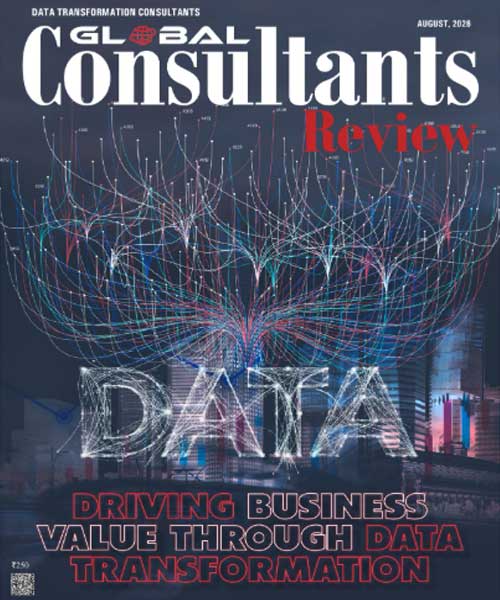

By Riddhi D, Senior Correspondent ,

In today's digital-first economy, data has become one of the most valuable assets for organizations. Every customer interaction, financial transaction, supply chain activity, employee engagement, and operational process generates vast amounts of data. However, having access to data alone does not guarantee success. Many organizations struggle with fragmented data systems, inconsistent data quality, outdated technologies, regulatory compliance, and the inability to derive meaningful insights from their information assets.
This is where data transformation consultants play a pivotal role. They bridge the gap between raw data and actionable business intelligence by helping organizations modernize their data ecosystems, establish governance frameworks, implement advanced analytics, and create scalable, AI-ready infrastructures.
Data transformation is not merely about migrating databases or adopting cloud technologies. It involves rethinking how data is collected, managed, secured, analyzed, and utilized across every function of an organization. Consultants provide the expertise, methodologies, and technological knowledge required to ensure businesses maximize the value of their data investments.
As artificial intelligence, machine learning, predictive analytics, and automation become central to business competitiveness, organizations increasingly rely on consultants to guide their data transformation journeys. Whether it is a multinational enterprise modernizing legacy systems or a growing startup building a cloud-native data platform, consultants deliver the strategic direction and execution capabilities necessary for success.
Data transformation refers to the process of converting data into formats that are more suitable for analysis, reporting, integration, and business decision-making. It encompasses a wide range of activities including:
The objective is to transform disconnected and unstructured information into reliable, accessible, and valuable business intelligence.
Modern organizations face several data-related challenges:
Data Silos
Departments often operate independently using different software systems. Sales, finance, HR, marketing, procurement, and operations each maintain separate databases, preventing seamless information sharing.
Poor Data Quality
Duplicate records, inconsistent formatting, missing information, and outdated databases reduce decision accuracy.
Legacy Systems
Many businesses continue operating decades-old ERP systems and databases that cannot support modern analytics.
Regulatory Compliance
Organizations must comply with regulations such as GDPR, HIPAA, CCPA, India's Digital Personal Data Protection Act, and industry-specific security requirements.
Rising Customer Expectations
Customers expect personalized experiences based on real-time insights, requiring integrated and intelligent data ecosystems.

Consultants serve as strategic advisors and implementation partners throughout the transformation lifecycle.
Their responsibilities include:
Rather than focusing solely on technology, consultants align data strategies with broader business objectives.
Every successful transformation begins with understanding the organization's existing environment.
Consultants conduct detailed assessments that evaluate:
These assessments identify capability gaps and opportunities for improvement.
Organizations receive a maturity score indicating how effectively they currently manage data.
One of the biggest mistakes companies make is implementing technology without strategy.
Consultants help answer questions such as:
The resulting roadmap ensures investments deliver measurable business value.
Disconnected systems limit organizational visibility.
Consultants integrate data across:
Unified data enables enterprise-wide reporting and better decision-making.
Poor-quality data can undermine even the most sophisticated analytics initiatives.
Consultants implement:
High-quality data significantly improves business intelligence accuracy.
Many enterprises still rely on outdated infrastructure.
Consultants help organizations migrate from legacy environments to modern cloud platforms without disrupting operations.
Migration projects often involve:
Cloud computing has revolutionized enterprise data management.
Consultants help deploy platforms such as:
Cloud platforms offer scalability, security, and reduced operational costs.
Without governance, transformed data quickly becomes unreliable.
Consultants establish governance policies covering:
Effective governance builds trust across the organization.
Data transformation is only valuable if it supports informed decisions.
Consultants implement dashboards and reporting systems that provide:
Interactive dashboards reduce manual reporting while improving decision speed.
AI depends entirely on quality data.
Consultants ensure organizations develop:
These foundations accelerate AI adoption.
As organizations centralize data, cybersecurity becomes increasingly important.
Consultants implement:
Security remains embedded throughout transformation initiatives.
Healthcare
Hospitals integrate electronic medical records, laboratory systems, imaging platforms, and patient portals to improve care coordination and clinical decision-making.
Banking
Banks transform transaction data into fraud detection systems, personalized financial services, and risk analytics.
Retail
Retailers combine online and offline customer data to optimize inventory, personalize marketing campaigns, and improve customer loyalty.
Manufacturing
Manufacturers integrate IoT sensors, production systems, and supply chain data to improve operational efficiency and predictive maintenance.
Education
Educational institutions analyze student performance, admissions, and operational data to improve learning outcomes and institutional planning.
Successful data transformation consultants possess expertise in:
Equally important are communication, leadership, stakeholder management, and business acumen.
Organizations often encounter:
Consultants mitigate these risks through structured methodologies and best practices.
AI-Powered Data Engineering
Generative AI is automating data cleansing, pipeline development, documentation, and analytics.
Real-Time Analytics
Organizations increasingly require live dashboards powered by streaming data.
Data Mesh
Instead of centralized ownership, domains manage their own trusted datasets.
Data Fabric
Modern architectures automatically connect distributed data sources.
Self-Service Analytics
Employees increasingly analyze data independently without IT assistance.
ESG Reporting
Consultants help organizations collect sustainability metrics for environmental reporting.
Consultants evaluate transformation success using metrics such as:
Organizations that achieve lasting success typically:
Technology alone cannot transform an organization. Successful initiatives require cultural change. Consultants often act as change leaders, helping employees understand the value of data-driven decision-making, encouraging collaboration between business and IT teams, and fostering a mindset of continuous improvement.
Workshops, training sessions, executive coaching, and communication plans are essential components of successful transformation programs. By addressing concerns early and involving stakeholders throughout the process, consultants improve user adoption and ensure that new systems become embedded in daily operations.
Over the next decade, the demand for data transformation consultants is expected to continue growing as organizations embrace AI, edge computing, automation, and digital ecosystems. Consultants will increasingly shift from being implementation specialists to strategic innovation partners, helping businesses unlock value from predictive analytics, autonomous decision-making, and intelligent business processes.
Organizations that successfully transform their data capabilities will be better positioned to innovate faster, respond to market changes, improve customer experiences, and maintain a competitive advantage. Those that delay modernization risk falling behind in an increasingly data-centric global economy.
Data has become the foundation of modern business strategy, but its true value can only be realized through effective transformation. Consultants play an indispensable role by combining strategic insight, technical expertise, industry knowledge, and change management capabilities to guide organizations through every stage of the journey.
From assessing data maturity and modernizing legacy systems to implementing cloud platforms, strengthening governance, enabling AI, and fostering a data-driven culture, consultants ensure that technology investments translate into measurable business outcomes. Their expertise helps organizations reduce risk, accelerate innovation, improve operational efficiency, and create sustainable competitive advantages.
As businesses continue to generate unprecedented volumes of information, the importance of data transformation consulting will only increase. Organizations that partner with experienced consultants are better equipped to convert complex data into actionable intelligence, empowering leaders to make faster, smarter, and more confident decisions in an increasingly digital world.
1. What is data transformation?
Data transformation is the process of converting raw, fragmented, or unstructured data into accurate, consistent, and usable information for analytics, reporting, AI, and business decision-making.
2. Why do organizations need consultants for data transformation?
Consultants provide strategic expertise, technical knowledge, proven methodologies, and implementation support to reduce risks, accelerate transformation, and maximize return on investment.
3. How long does a data transformation project take?
Project timelines vary based on complexity, but most enterprise data transformation initiatives take 3 to 18 months.
4. Which industries benefit most from data transformation?
Almost every industry benefits, including:
5. What are the key outcomes of data transformation?
Successful data transformation delivers:
We use cookies to ensure you get the best experience on our website. Read more...