
By Tharani Sambu, Content Writer ,
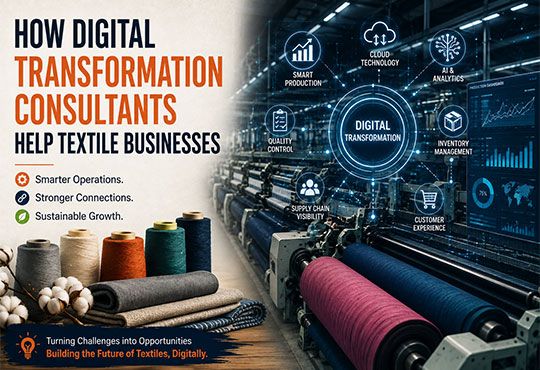
Digital technology is becoming an important part of how businesses work. From managing daily operations and production to understanding customers and making business decisions, companies are increasingly using digital tools to become more efficient and competitive. This shift toward using technology to improve business processes is known as digital transformation.
But adopting digital technology is not always simple. This is where digital transformation consultants come in. They help businesses understand where technology can make the biggest difference. They study existing processes, identify challenges and recommend suitable digital solutions based on the company's needs and goals. Depending on the project, they may also support implementation, employee training and measuring results.
The role of these consultants becomes particularly relevant in industries such as textiles, where businesses manage complex processes ranging from raw materials and manufacturing to inventory, supply chains and customer sales.
The textile industry is much more than manufacturing clothes. It includes yarn production, fabric manufacturing, dyeing and finishing, garment production, quality control, inventory management, supply-chain coordination and sales.
Behind every finished garment or textile product is a series of connected processes. Businesses need to manage raw materials, machinery, production schedules, workers, suppliers, inventory, orders and deliveries. When these activities depend heavily on manual processes or disconnected systems, managing the business can become more difficult as it grows.
At the same time, customer preferences are changing quickly. Buyers expect better product choices, faster responses and convenient digital interactions. Textile companies therefore need better ways to understand demand, improve production and respond to the market.
Technologies such as cloud platforms, data analytics, automation, artificial intelligence, digital management systems and e-commerce platforms can help improve different parts of these operations. However, not every business needs every technology. The right solution depends on its size, processes, goals and challenges.
Digital transformation consultants begin by understanding how a textile business currently operates. Instead of immediately suggesting a technology, they examine existing processes and look for areas where the business may be losing time, resources or valuable information.
For example, a textile company may have difficulty tracking inventory, monitoring production, coordinating suppliers or understanding customer demand. A consultant can analyze these challenges and determine where digital technology could provide a practical solution.
The process can be understood simply:
Understand the business → Identify challenges → Develop a digital strategy → Select suitable technology → Support implementation → Measure results
“Biggest challenge for India is to evolve around smart factory concept. "— Rohit Pandit, Director, Intex Consulting Group–VTMtex Virtual Textile Mill India Pvt. Ltd.
Production is one of the most important areas for a textile business. A company may need to coordinate raw materials, machinery, workers, production schedules and quality checks.
When production information is recorded manually, managers may find it difficult to see what is happening across the factory.
A digital transformation consultant can study the production workflow and identify opportunities for digital production-management systems. These tools can help businesses monitor production progress, track orders and identify potential delays.
The goal is not simply to introduce software. It is to create a better way for the business to monitor and manage its production process.
Textile businesses often handle large quantities of yarn, fabric, dyes, accessories and finished products. Managing this inventory accurately is essential.
When stock is tracked manually, businesses may face incorrect records, excess inventory or difficulty knowing what materials are available.
Digital transformation consultants can assess the inventory process and recommend digital inventory-management solutions. These systems can provide better visibility into stock levels and help employees access updated information more easily.
This can make it easier for businesses to plan purchases and manage materials.
The textile supply chain can involve suppliers, manufacturers, distributors and customers. If information is spread across emails, spreadsheets and separate systems, tracking orders and deliveries can become challenging.
Consultants can identify these information gaps and recommend digital systems that improve supply-chain visibility. This may help companies coordinate suppliers, monitor orders and track shipments more effectively.
A more connected supply chain can also help businesses respond faster when there are delays or changes in demand.
Textile businesses generate large amounts of data from sales, production, inventory and customers. The challenge is turning that information into something useful.
Digital transformation consultants can help companies adopt data analytics and business intelligence tools to understand performance.
For example, sales data can show which products are performing well, production data can highlight delays, and customer data can provide insights into buying preferences.
Instead of relying only on assumptions, businesses can use this information to support better decisions.
AI and automation are becoming important parts of digital transformation.
A consultant can examine a textile company's processes and identify tasks that may be suitable for automation. Depending on the business, AI could potentially support demand forecasting, quality inspection, customer service or data processing.
Automation can also help with repetitive activities such as data entry, reporting and order processing.
However, businesses should not adopt AI simply because it is popular. A digital transformation consultant should first determine whether AI is appropriate for the particular problem and whether the expected value justifies the investment.
Digital transformation can also extend to the customer side of a textile business.
A company may use a website, B2B ordering platform, CRM system or e-commerce platform to improve communication with customers and manage orders.
For example, a textile manufacturer selling to retailers can use a B2B platform to allow buyers to view products and place orders digitally. A CRM system can help organize customer information, sales interactions and communication.
However, this is only one part of digital transformation.
It is easy to think that digital transformation simply means putting a business online.
For a textile company, having a website or selling products online can certainly be part of the transformation. But digital transformation goes much further.
It can involve:
This is why digital transformation consultants have a broader role than website developers or digital marketing professionals. Their focus is on understanding how the entire business operates and identifying where digital technology can improve that operation.
The textile industry is highly competitive, and businesses need to manage efficiency, quality, costs, customer expectations and changing demand at the same time.
Digital transformation can help businesses gain better visibility into their operations and make information available more quickly. It can also reduce dependence on manual processes and support more informed decision-making.
For example, a manager who previously waited for manually prepared inventory reports may be able to access updated information through a digital dashboard. A production team may identify delays earlier through digital monitoring, while a sales team can use customer data to understand which products are generating demand.
These improvements can help businesses become more efficient, connected and responsive.
The value of a digital transformation consultant is not simply knowing about the latest technology. It is about understanding which technology can solve a particular business problem.
A consultant studies the company's existing processes, identifies areas that are slowing down operations and looks for opportunities to improve them through suitable digital solutions. This may include reviewing manual processes, understanding how business data is being used, identifying opportunities for automation and assessing whether AI can provide practical value.
The consultant also considers how different digital systems can work together and how employees can adapt to new technologies. This helps businesses avoid investing in technology without a clear purpose.
“The most successful manufacturers don't start with technology. They start with business outcomes and work backward to the technologies required.” — Harsh Kumar, Partner, Technology Consulting, EY India
The transformation can therefore be viewed as:
Business problem → Analysis → Digital solution → Implementation → Business improvement
Digital transformation in the textile industry is likely to become increasingly connected with AI, automation, data analytics, cloud technology and smarter production systems.
As these technologies develop, textile businesses will have more opportunities to improve manufacturing, manage supply chains, understand customers and make decisions.
However, successful transformation depends on more than technology. Businesses also need clear strategies, skilled employees, appropriate systems and a willingness to adapt.
This creates an ongoing role for digital transformation consultants. They can help businesses evaluate opportunities, prioritize investments and connect technology with actual business objectives.
Digital transformation is changing how businesses operate, and the textile industry is no exception. From manufacturing and inventory management to supply chains, customer relationships, data and AI, digital technology can influence almost every part of a textile business.
Digital transformation consultants can help textile companies navigate this change by understanding their existing processes, identifying challenges and recommending suitable digital solutions. Depending on the engagement, they can also support implementation and help businesses measure the results.
Ultimately, digital transformation is not about replacing everything a textile company already does. It is about finding better ways to work, using technology with a clear purpose and building a business that is more efficient, connected and ready for changing market needs.
We use cookies to ensure you get the best experience on our website. Read more...