
By Tharani Sambu, Content Writer ,
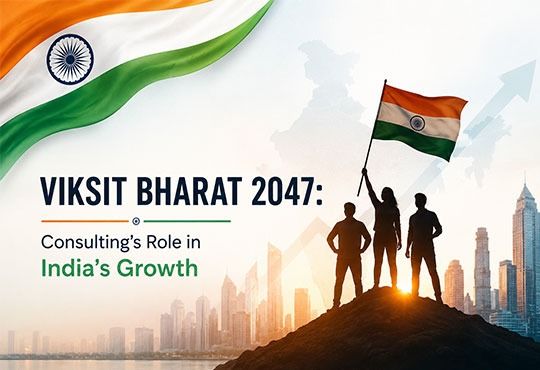
As India prepares to mark its 80th Independence Day, the focus is not only on the country's journey since 1947 but also on where India wants to be in the next two decades. The vision of Viksit Bharat 2047 aims to build a developed, innovative and globally competitive India by the time the country celebrates 100 years of independence.
This year's Independence Day focus on “Yuva Shakti for Viksit Bharat@2047” puts India's young population at the centre of this journey. For businesses, achieving this vision will require more than government initiatives. Companies will need to adapt to changing technology, develop skilled talent, improve productivity and compete in increasingly global markets.
This is where business consulting can play an important role.
“It is humans in the lead, not humans in the loop, that will determine our future.” — Julie Sweet, Chair & CEO, Accenture
Sweet's observation highlights an important point for India's growth journey: technology can provide powerful tools, but people and business leaders ultimately determine how those tools are used to create meaningful outcomes.
India's growth story is creating opportunities across manufacturing, technology, healthcare, infrastructure, financial services, retail and other sectors. At the same time, businesses are facing challenges such as changing customer expectations, digital disruption, rising competition and the need for sustainable growth.
Consulting firms can help businesses respond to these changes by bringing specialised knowledge, industry experience and structured strategies.
Rather than simply recommending what a company should do, consultants increasingly work alongside business leaders to identify problems, evaluate opportunities and turn strategies into practical initiatives.
For a growing Indian company, this could mean entering a new market, improving its supply chain, adopting artificial intelligence or restructuring operations to become more efficient.
Technology will be one of the major drivers of India's development toward 2047. Artificial intelligence, cloud computing, automation, data analytics and digital platforms are changing the way businesses operate.
However, adopting new technology is not as simple as purchasing a software solution. Businesses need to understand where technology can create real value and how it can be integrated into existing operations.
Technology and digital transformation consultants can help companies assess their current systems, identify opportunities for automation and develop practical technology roadmaps. They can also help organisations manage the people and process changes that come with digital transformation.
For small and mid-sized businesses in particular, the right consulting support can make advanced technology more accessible and help them compete with larger organisations.
India's youth will be an important part of the Viksit Bharat 2047 vision. A large and increasingly skilled workforce can support entrepreneurship, innovation and productivity across industries.
Businesses, however, need to prepare for a workplace that is changing quickly. Employees require new digital skills, while organisations need better approaches to talent development, leadership and workforce planning.
HR and business consultants can help companies build future-ready teams by identifying skill gaps, improving training programmes and developing strategies for attracting and retaining talent.
The role of consulting here goes beyond solving an immediate staffing problem. It is about helping businesses create an environment where people can learn, innovate and contribute to long-term growth.
India's ambition to become a developed economy will also depend heavily on the strength of its manufacturing and supply-chain ecosystem.
Businesses are increasingly looking at ways to improve production efficiency, reduce costs, strengthen supply chains and meet international quality standards. Consultants can support these efforts through operational improvement, supply-chain planning, process optimisation and market strategy.
For Indian manufacturers looking to expand globally, consultants can also provide valuable support in areas such as market entry, international operations, risk management and regulatory requirements.
This becomes particularly important as Indian companies move from serving domestic markets to competing on a larger global stage.
Economic growth and sustainability are becoming increasingly connected. Businesses are under growing pressure from customers, investors and regulators to reduce environmental impact while maintaining profitability.
Sustainability consultants can help organisations identify areas where they can reduce energy consumption, manage resources more efficiently and develop responsible business practices.
For companies planning for long-term growth, sustainability is no longer simply a corporate responsibility initiative. It can influence operating costs, brand reputation, investment decisions and access to global markets.
The journey toward Viksit Bharat 2047 will involve millions of businesses making decisions that shape India's economy. Not every organisation will face the same challenges, and there is no single strategy that will work for every company.
This is where the value of consulting becomes clearer.
A manufacturing company may need help modernising its production systems. A technology startup may need support with scaling operations. A traditional business may need a digital transformation strategy, while an established company may require assistance entering international markets.
Consultants can help businesses connect these individual challenges with larger growth opportunities.
The focus is increasingly shifting from simply identifying problems to helping organisations implement solutions and measure results. This makes consulting a potential bridge between India's broader development ambitions and the practical decisions businesses make every day.
India's development journey is also creating opportunities for the consulting industry itself.
As businesses become more sophisticated, demand is likely to grow for specialised expertise in areas such as AI consulting, digital transformation, sustainability, cybersecurity, supply-chain management, financial advisory, HR consulting and strategy.
At the same time, consulting firms will need to understand the realities of India's diverse business landscape. Solutions designed for a large multinational may not work for a growing Indian SME, a regional manufacturer or a new-age startup.
The most valuable consultants will therefore be those who can combine global knowledge with a practical understanding of Indian businesses.
Viksit Bharat 2047 is ultimately a long-term national vision, but its progress will be shaped by decisions being made today.
Businesses that invest in technology, people, innovation, productivity and sustainable growth will be better positioned to participate in India's next phase of development. Consulting can support that journey by helping organisations make those decisions with greater clarity and turn ambitious plans into measurable action.
As India looks toward its centenary of independence in 2047, the opportunity is not simply to build a larger economy. It is to build businesses that are more innovative, resilient, competitive and prepared for the future.
For India's consulting industry, that journey represents not just a responsibility, but a significant opportunity to help shape the businesses that will power the next chapter of India's growth.
We use cookies to ensure you get the best experience on our website. Read more...