

By Global Consultants Review Team ,
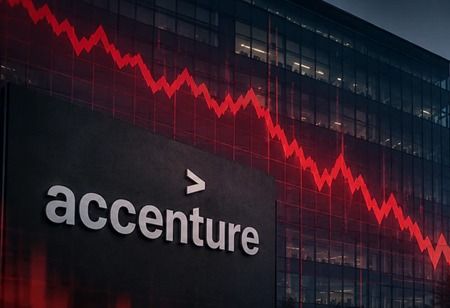
What began as a disappointing earnings update from global consulting and technology giant Accenture quickly turned into one of the biggest single-day sell-offs for Indian IT stocks this year.
On Friday, investors rushed to exit technology counters after Accenture slashed its growth outlook and reported weaker-than-expected bookings, raising fresh concerns about global technology spending.
The fallout was immediate. India's Nifty IT Index plunged nearly 6%, making it the worst-performing sector on Dalal Street, while market leaders Infosys, TCS, HCLTech, Tech Mahindra, Wipro, LTIMindtree, and Mphasis witnessed sharp declines.
The sell-off wiped out nearly ₹1.35 lakh crore in market capitalization from India's leading IT companies in a single trading session, according to market estimates.
For investors, Accenture is more than just another consulting company.
The company is widely regarded as a bellwether for global technology spending because it serves thousands of clients across industries and geographies. Its quarterly results often provide an early indication of how corporations are allocating budgets for digital transformation, cloud migration, cybersecurity, artificial intelligence, and consulting services.
When Accenture lowered its revenue growth expectations and reported softer bookings, investors interpreted the move as a warning that enterprise technology spending remains under pressure.
That is particularly important for India.
The country's largest IT services companies derive a significant share of their revenue from North America and Europe. If global corporations slow technology spending, Indian firms are often among the first to feel the impact.
"Accenture's guidance is closely watched because it serves as a proxy for worldwide IT demand," said one Mumbai-based market strategist. "When Accenture becomes cautious, investors assume the same pressures could eventually affect Indian service providers."
Ironically, the trigger for the sell-off comes at a time when artificial intelligence is being promoted as the next major growth engine for the technology sector.
Over the last two years, consulting firms and IT service providers have announced billions of dollars in AI-related deals, partnerships, and investments. Yet Accenture's latest results suggest that the monetization of AI may not be progressing as rapidly as markets expected.
Many enterprises continue to experiment with AI through pilot projects rather than committing to large-scale deployments. While demand exists, companies remain cautious about governance, cybersecurity, regulation, and return on investment.
For investors who expected AI spending to offset broader weakness in technology budgets, the latest guidance came as a disappointment.
Among Indian IT majors, Infosys emerged as one of the worst-hit stocks, falling as much as 8% during the session. TCS, Tech Mahindra, HCLTech, LTIMindtree, Mphasis, and Wipro also witnessed significant declines as investors reassessed growth expectations for the sector.
The broader impact was visible across the market.
The Sensex and Nifty came under pressure as heavyweight IT stocks dragged benchmark indices lower. Foreign institutional investors, already cautious amid global uncertainty, trimmed exposure to technology counters, further accelerating the decline.
While Accenture's guidance served as the immediate trigger, analysts believe the market reaction reflects deeper concerns.
First, discretionary technology spending remains subdued. Many corporations continue to delay large transformation projects amid economic uncertainty.
Second, artificial intelligence is creating structural questions for the traditional IT services model. Investors are increasingly asking whether AI will generate new opportunities or reduce demand for some services historically provided by consulting and outsourcing firms.
Third, geopolitical tensions and slowing economic growth in key markets are adding another layer of uncertainty.
Accenture itself cited weakness related to Middle East operations and softer demand conditions in some parts of its consulting business.
Not everyone believes the sell-off signals a prolonged downturn.
Several analysts argue that while growth may moderate in the near term, long-term demand drivers remain intact. Cloud computing, cybersecurity, digital transformation, data modernization, and AI adoption continue to represent multi-year opportunities for both global consulting firms and Indian IT providers.
However, the market's reaction highlights a changing reality.
For years, investors viewed the Indian IT sector as one of the most predictable growth stories in the market. Today, the industry faces a more complex environment shaped by AI disruption, shifting client priorities, geopolitical risks, and evolving business models.
Accenture's earnings report may not determine the future of Indian IT. But Friday's market reaction demonstrates how closely global consulting trends and Indian technology stocks have become intertwined.
For investors, the message was unmistakable: what happens in Accenture's boardroom can still send shockwaves across Dalal Street.
We use cookies to ensure you get the best experience on our website. Read more...