
By Tharani Sambu, Content Writer ,
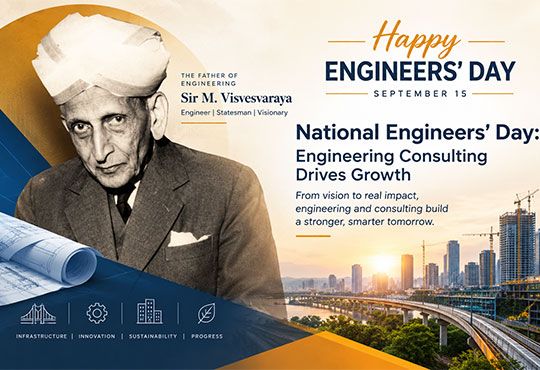
India observes National Engineers’ Day today, September 15 -2026, in honour of Bharat Ratna Sir Mokshagundam Visvesvaraya, whose birth anniversary is commemorated every year as Engineers’ Day.
The occasion recognizes the contribution of engineers to infrastructure, technology, industrial development and nation-building.
In today's rapidly changing business environment, the significance of engineering extends beyond technical execution, with engineering expertise increasingly becoming part of consulting, strategic planning, digital transformation and sustainable development.
Engineering consultants help organizations evaluate complex projects, manage risks and make informed decisions by combining technical knowledge with business understanding.
Their role is also expanding into areas such as energy efficiency, resilient infrastructure and long-term project planning, helping businesses and governments create solutions that are practical, cost-effective and future-ready.
National Engineers’ Day is observed on September 15 in honour of Sir Mokshagundam Visvesvaraya, who was born on September 15, 1861.
Visvesvaraya made major contributions to irrigation, flood management and infrastructure development.
His career also extended into administration, industrial development and economic planning during his tenure as Diwan of Mysore.
His legacy demonstrates that engineering can extend well beyond technical design.
Engineers can contribute to planning, public policy, infrastructure development, institutional improvement and economic progress.
That broader role is particularly relevant to modern consulting, where engineers increasingly work alongside business leaders, policymakers, investors, technology professionals and project managers.

Engineering is the application of science, mathematics, technology and practical knowledge to design, develop, build, improve and maintain products, systems and infrastructure.
Engineers use technical knowledge and problem-solving skills to turn concepts into practical solutions for real-world challenges.
The profession covers multiple disciplines, including civil, mechanical, electrical, electronics, chemical, computer, aerospace and environmental engineering.
Each discipline contributes to different aspects of economic and social development, from transportation and energy systems to manufacturing, telecommunications, digital technologies and sustainable infrastructure.
Engineering is therefore more than designing machines or structures.
At its core, it is a problem-solving discipline that helps organizations and society use resources more effectively, improve safety and efficiency, develop new technologies and address complex challenges.
Engineering provides the technical foundation for modern economies. Roads, bridges, railways, airports, power networks, manufacturing plants, communication systems and digital platforms all depend on engineering knowledge.
Engineers help organizations develop safer systems, increase productivity, reduce technical risks and introduce innovative products and processes.
Their expertise is also important in areas such as renewable energy, water management, automation, healthcare technology, advanced manufacturing and climate-resilient infrastructure.
The importance of engineering is growing as businesses and governments face challenges involving urbanization, climate change, energy transition, digital transformation and resource efficiency.
Addressing these challenges requires practical technical solutions, increasing the demand for specialized engineering expertise.

India's infrastructure and industrial expansion is creating new opportunities for engineers and engineering-led consulting firms.
Large-scale projects require feasibility studies, technical assessments, engineering design, project planning, risk evaluation and technology integration.
Engineers contribute across sectors including transportation, energy, manufacturing, construction, water resources, urban development, telecommunications and emerging technologies.
As projects become more complex, organizations often require specialist knowledge that may not be available internally.
Engineering consultants can fill this gap by providing technical expertise and independent advice throughout the project lifecycle.

Engineering consulting connects technical expertise with business and project objectives.
Consultants can support organizations from the initial concept and feasibility stage through design, implementation, commissioning and operational improvement.
Their responsibilities may include technical assessments, cost analysis, project planning, engineering design, technology selection, environmental evaluation, risk management and project-management support.
For businesses, this expertise can help improve investment decisions and reduce technical and execution risks.
For governments and infrastructure developers, consultants can provide specialist knowledge for projects involving multiple technologies, contractors and stakeholders.
Engineering consulting has therefore evolved into an important bridge between technical innovation, project execution and commercial objectives.
 Infrastructure Creates New Consulting Opportunities :
India's continued infrastructure development is creating demand for engineering expertise across highways, railways, metros, airports, ports, bridges, tunnels, water systems and urban infrastructure.
Recent industry developments reflect this growing opportunity. RITES and MECON have entered into a collaboration to pursue consultancy and infrastructure opportunities in India and overseas.
The areas covered include railways, metros, highways, airports, ports, bridges, tunnels, urban transport, energy and water resources.
Such collaborations demonstrate how engineering organizations are increasingly expanding their role from conventional technical services toward broader consultancy and project-management capabilities.
The engineering consulting opportunity is also moving into sectors that are becoming strategically important to India's economy.
Semiconductors, renewable energy, advanced manufacturing, electric mobility, data infrastructure and industrial technology all require specialized engineering capabilities. Tata Consulting Engineers has identified sectors including energy, semiconductors, metals, infrastructure and manufacturing as areas for growth. The company is also investing in engineering software, artificial intelligence and digital capabilities while targeting $1 billion in revenue by FY31.
“Our objective is to become a $1 billion-revenue company by FY31. That is our stated goal, and we have developed our strategy around achieving it through a combination of organic growth, sector-specific expansion,country-specific growth and selective inorganic opportunities.” — Amit Sharma, Managing Director & CEO, Tata Consulting Engineers
The strategy reflects how modern engineering consulting is combining technical expertise with digital capabilities, industry specialization and strategic advisory services.

Artificial intelligence is becoming another important force in engineering.
AI, digital twins, Building Information Modelling, automation, advanced simulation and data analytics are changing how engineers design, evaluate and manage projects.
These technologies can help analyze large volumes of information, identify potential problems and support faster decision-making.
AI is also changing the skills required from engineers. Technical knowledge remains essential, but professionals increasingly need to understand AI-enabled workflows and digital technologies.
“For years, engineering advantage came from technical depth.Today, AI is raising that baseline.While foundational skills like programming and cybersecurity continue to be important, workflow automation and LLMOps are accelerating what engineers can build in the age of AI.” — Malai Lakshmanan, Head of India Engineering, LinkedIn
The changing technology environment is creating an opportunity for engineering consultants to combine traditional engineering knowledge with AI, automation and data-driven decision-making.
Engineering also has an increasingly important role in sustainable development.
Businesses and governments are evaluating energy consumption, emissions, water use, waste, materials and climate resilience when developing infrastructure and industrial projects. Engineers help turn sustainability objectives into practical technical solutions.
This can include renewable energy integration, energy-efficient systems, sustainable materials, water conservation, waste reduction and resilient infrastructure.
Engineering consultants can help organizations balance environmental goals with technical requirements, project costs and long-term operational performance.
The role of engineers is increasingly extending into strategic decision-making.
Large infrastructure and industrial investments can involve significant capital expenditure and long project lifecycles.
Technical assessments allow investors, project owners and businesses to understand feasibility, design requirements, operational challenges and potential risks before committing resources.
When engineering expertise is combined with financial, management, environmental and strategic consulting, organizations can develop a more comprehensive approach to major investments.
This combination is particularly valuable when technical performance directly influences the commercial success of a project.
Also Read : Viksit Bharat 2047: Consulting’s Role in India’s Growth
Indian engineering organizations are also expanding their consultancy capabilities across international markets.
Companies such as RITES, MECON, Tata Consulting Engineers and Engineers India Limited are involved in engineering consultancy and project-management activities across multiple sectors.
Engineers India Limited, for instance, has expanded its advisory involvement in maritime infrastructure, with capabilities covering engineering, project management, feasibility studies, infrastructure planning and technology integration.
The international expansion of Indian engineering capabilities demonstrates the potential for India's technical talent and consulting expertise to contribute to global infrastructure and industrial projects.

The future of engineering consulting is likely to be shaped by the convergence of technical expertise, artificial intelligence, sustainability and strategic advisory.
As infrastructure becomes more sophisticated and businesses adopt emerging technologies, organizations will need consultants who understand technical requirements while also considering commercial objectives, environmental impact, regulatory requirements and long-term performance.
Emerging sectors such as renewable energy, semiconductors, advanced manufacturing, smart infrastructure and digital engineering are expected to create additional opportunities for engineering consultants.
The ability to combine engineering fundamentals with digital and business knowledge will increasingly differentiate consulting professionals and firms.
National Engineers’ Day 2026 is therefore more than a celebration of the engineering profession.
It is an opportunity to recognize the expanding contribution of engineers to India's economic and technological ambitions.
From designing infrastructure and developing new technologies to advising organizations on sustainability, investment and digital transformation, engineering expertise is becoming increasingly connected to strategic decision-making.
As India continues to invest in infrastructure, technology and industrial development, engineering consultants are positioned to play an important role in converting ambitious plans into practical, scalable and sustainable outcomes.
The evolution of engineering consulting shows that engineers are moving beyond the traditional project site and into strategic discussions around innovation, investment, technology and business transformation. Their technical expertise, combined with consulting capabilities, can become an important foundation for India's next phase of growth.
We use cookies to ensure you get the best experience on our website. Read more...